Inclusive by Design: The Role of Multi-Faith Spaces in Football
Improved attitudes and understanding shown by clubs such as Liverpool FC
VERSUS is a media platform and fan community championing the future of football and its impact on culture and society. What makes this platform stand out is both the quality of the writing and the wide range of topics covered, from fashion and music to sexism, racism and religion, as well as aspects of the game itself, of course.
On the subject of religion, Ahmed Shooble wrote last April that “the sport hasn’t always been the most Muslim-friendly space. Gambling sponsors and a prominent drinking culture exist in most footballing corners of the world – turning enjoyment of the game into a bit of an ethical labyrinth for practising Muslims to navigate.”
He went on however, to comment on the improved attitudes and understanding shown by football managers towards Muslim players who fast during Ramadan, and to show his appreciation of Mohammed Salah, both on and off the pitch. Liverpool FC support their diverse fanbase by providing a multi-faith room for use on match days, and they are by no means the only club to do this.
The importance of providing for the traditions of different faiths without causing offence to any
In today’s pressured world, there is a real need for people to have a quiet space for reflection, meditation or prayer in the workplace, and this includes sports stadia, which are often situated in large cities, with staff, players and supporters coming from different backgrounds and cultures.
If such space is to be used for prayer it must by law, be available to everyone without discrimination. It must, therefore, provide for the traditions of different faiths without causing offence to any. Hence the concept of a multi-faith room, also sometimes known as a quiet room or wellbeing room. For practical advice, “Diversity Matters,” WuduMate’s Guide to Best Practice Multi-Faith Room Design” is available here.
Arsenal FC committed to providing inclusive spaces
In spring 2024, Arsenal FC created a prayer room for their players at the Emirates Stadium in north London. On www.arsenal.com Arsenal Media reported that “this addition reflects our commitment to providing inclusive spaces for individuals of all faiths to practice their beliefs.”
Blackburn Rovers FC adds wudu facilities to prayer room
Another club which has done much to promote social cohesion and to make all fans feel welcome, is Blackburn Rovers (winners in November 2023 of the Ihsan Award for Excellence in Diversity and Inclusion at the Islam Channel Business Awards), who were aware of the need to provide their Muslim fans and staff with facilities to pray and perform wudu, the Islamic pre-prayer ablution ritual. As reported on their news page in January 2023 on www.rovers.co.uk “Rovers have taken another positive step to becoming a fully inclusive and accessible club by upgrading its multi-faith facility at the Blackburn End. The club has installed a WuduMate next to its prayer room thanks to a generous donation from the club’s charity partner Benefit Mankind.”
WuduMate Modular
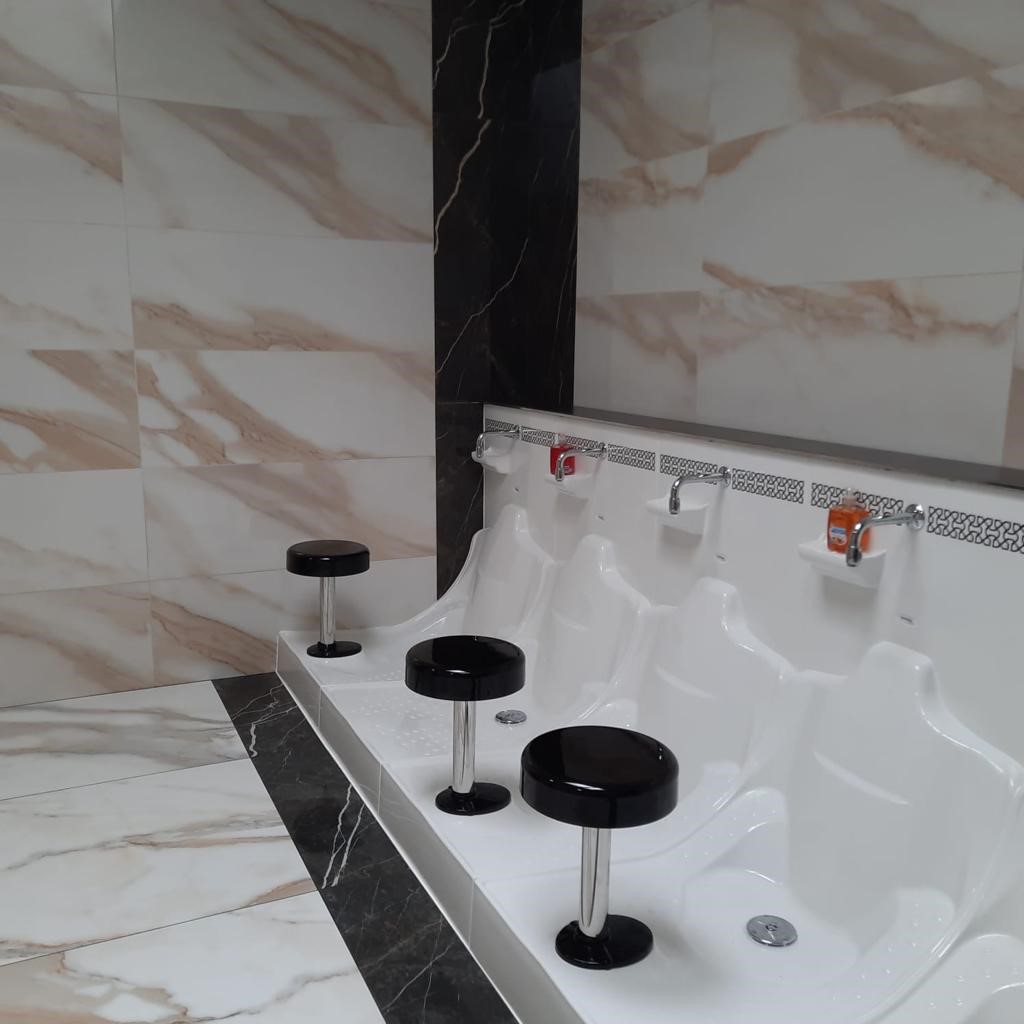
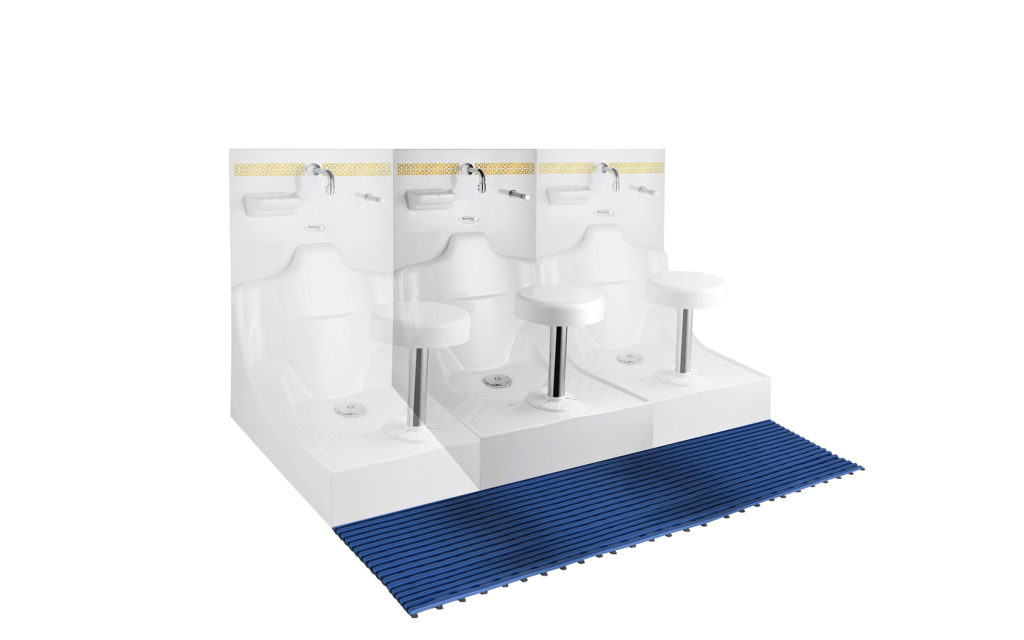
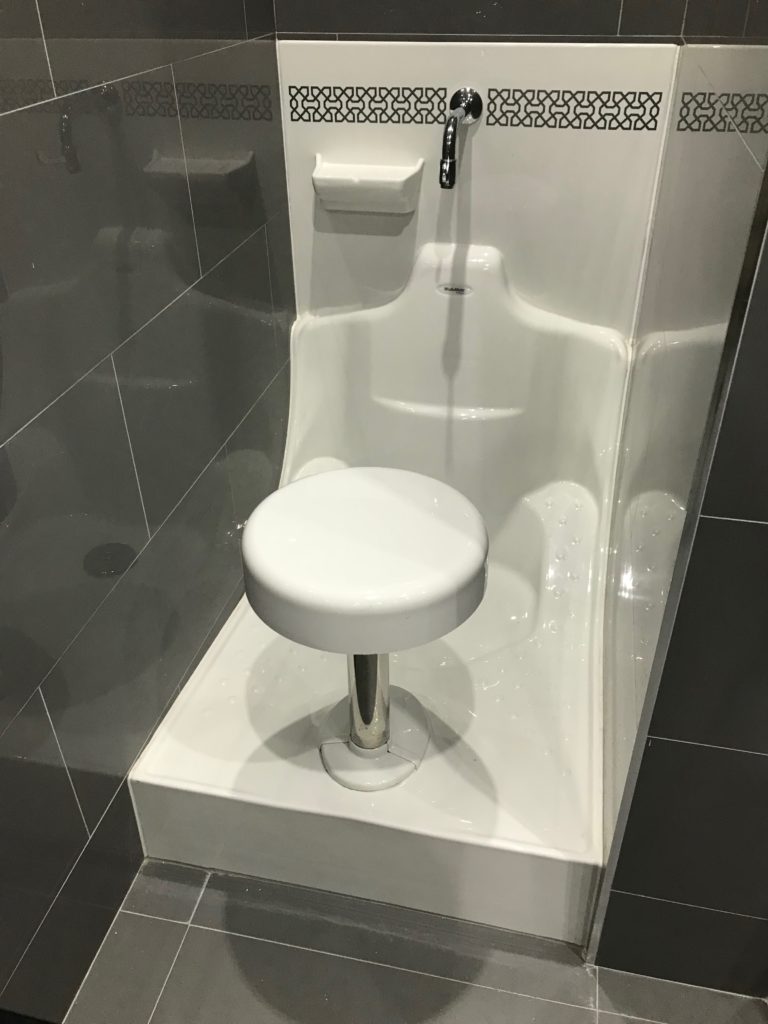
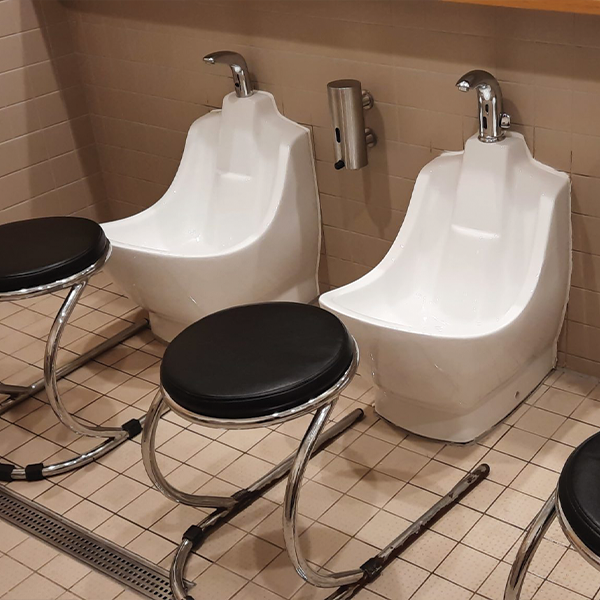
The model chosen for ablution was the WuduMate Modular. Manufactured in the UK, in high quality, easy to clean sanitary grade acrylic, the WuduMate Modular is designed for high usage, communal ablution environments. A choice of compatible WuduMate taps is available, designed to ensure that the spouts are in the most comfortable position for wudu and at the right angle to minimise splashing.
Collective embrace of diversity and inclusivity within football
Bruk Abdu is the Social Inclusion Manager for Arsenal in the Community. In an interview with Brian Matovu published on www.arsenal.com, he talks about his experiences of Ramadan while working for the club. His positive conclusion indicates that, while discrimination still exists in football, the situation is improving: “the fact that players, authorities and fans alike now show acceptance and understanding of different cultures is truly, commendable. It demonstrates a collective embrace of diversity and inclusivity within football, fostering a sense of unity and togetherness among all involved.”
Please contact sales@wudumate.com if you require a quote or further information about the WuduMate range of ablution products.
This article was originally published by Barbour Product Search as Multi-Faith Rooms in Football Stadia
WuduMate partners with Umbrella Faith
We are pleased to announce that WuduMate has signed a partnership with Umbrella Faith Ltd.
Whether you’re designing a new multi-faith room or updating existing facilities, Umbrella Faith can supply prayer mats that are personalised with your corporate colours and logo, to foster a sense of belonging among your Muslim community.
Umbrella Faith: Enhancing Spiritual Well-Being at Work
At Umbrella Faith, we believe that prayer and well-being should be accessible, dignified, and supported in every environment. That’s why we’ve partnered with WuduMate – a global leader in ablution facilities – to provide beautifully crafted, ethically sourced prayer mats that complement any multi-faith space, office, school, or sports facility.

Faith-Inspired Well-Being Prayer Mats
- Custom-branded with your organisation’s logo or message
- Ethically produced in Turkey from a high-quality cotton, polyester, and viscose blend
- Plush, soft-touch design for comfort during prayer or reflection
- Ideal for multi-faith rooms, well-being zones, and private contemplation
Dimensions: 117.5 × 69.5 cm
Weight: 0.65 kg


Why buy personalised Prayer Mats from Umbrella Faith?
✅ Promotes diversity, inclusion, and religious accommodation
✅ Designed by a Muslim professional with lived experience in corporate spaces
✅ Trusted by leading organisations, including:
- Cardiff City FC
- Glamorgan Cricket
- McDonald’s
- Royal Navy
- The British Army
A Shared Vision
As part of the WuduMate Multi-Faith Room design and consultancy service, we will recommend suitable ablution facilities for your users, but we will also suggest appropriate fixtures and furnishings, so that all the people who want to use your multi-faith space will find what they need and feel welcome.
You can find more information about this in our booklet
Diversity Matters: Guide to Best Practice Multi-Faith Room Design
Download your copy today.
Together, WuduMate and Umbrella Faith are committed to fostering environments where everyone feels spiritually supported and culturally respected.
Visit the Umbrella Faith website: www.umbrellafaith.co.uk
“I didn’t always have a mineral water bottle to hand when I wanted to wash, and taking cups of water into a toilet is not always practical, so the WuduMate is ideal. It can be easily carried in your pocket or handbag, can hold a litre of water which is far more than the small water bottles which we normally use, and after use can be easily folded away again for use next time.”
WuduMate Classic reaches the Final of the Architizer A+ Product Awards
The WuduMate Classic has been selected as a Finalist in the Architizer A+Product Awards Positive Impact category.
The Architizer A+Awards is an annual architectural awards program that recognises and celebrates the best architecture and spaces from around the world. It’s the largest awards program of its kind, focused on promoting and celebrating the year’s best architecture and spaces.
The Positive Impact Award celebrates building products that do good for the environment or society as a whole. Eligible products include products that are designed to be accessible to communities of all socio-economic contexts, products that are expressly non-harmful to people and the environment, or the product of a business model with humanitarian or other socially ethical goals.
The WuduMate Classic is central to WuduMate’s range of footbaths and accessories for the Muslim pre-prayer ablution ritual of wudu. This model enables the safe, hygienic, comfortable, and dignified performance of wudu by adults and children and, like every WuduMate model, can be configured with some level of accessibility for disabled users.
WuduMate has always listened attentively to its customers around the world, thereby improving design and manufacturing in order to arrive at excellent product functionality and quality. The Classic started life as The Commercial in 2008. This product design, while innovative, was just the beginning of the development of today’s CSA certified Classic, whose design improves the user’s experience through its great attention to ergonomic detail.
Vote for the WuduMate Classic on the Architizer website here .
Positive feedback from happy staff demonstrates that the inclusion of a WuduMate Classic “...eliminates the awkwardness of performing pre-prayer ablution in public bathrooms” and that people are “proud to work for a company that is committed to making everyone feel welcome.
“I didn’t always have a mineral water bottle to hand when I wanted to wash, and taking cups of water into a toilet is not always practical, so the WuduMate is ideal. It can be easily carried in your pocket or handbag, can hold a litre of water which is far more than the small water bottles which we normally use, and after use can be easily folded away again for use next time.”

New Product – WuduMate Portable Bidet
We introduced our new range of bidet sprays/shattafs last year, and they have been very successful.
we are hearing back from some of our customers that they are not able/allowed to plumb in a bidet spray in their bathroom.
So we have launched a new product – a battery operated bidet spray that can sit alongside the toilet in your bathroom. The unit looks very discreet – you can fill it with water at room temperature, and the shattaf spray is powered by battery. This unit is perfect for homes and small business premises.
Please Contact Us if you would like some more information about this product, or any of our other Bidet Sprays or Shattafs.


“I didn’t always have a mineral water bottle to hand when I wanted to wash, and taking cups of water into a toilet is not always practical, so the WuduMate is ideal. It can be easily carried in your pocket or handbag, can hold a litre of water which is far more than the small water bottles which we normally use, and after use can be easily folded away again for use next time.”
WuduMate achieves ISO 9001 Certification
We are pleased to announce that WuduMate has achieved the International Quality Standard ISO9001 in January 2025.
ISO 9001 is a globally recognized standard for quality management
Implementing ISO 9001 means that our organisation has put in place effective quality processes in all areas and trained staff to deliver flawless products and customer satisfaction, time after time.
We have been externally audited, and certified that our quality procedures and standards are acceptable and compliant with the standard.
What does this mean for our customers:
- Trust and Satisfaction: Our company has robust quality control processes in place across all departments, and all staff are aware of them.
- Effective complaint resolution: ISO 9001 offers guidelines for resolving customer complaints efficiently.
- Process improvement: The standard helps identify and eliminate inefficiencies, reduce waste, streamline operations, and promote informed decision-making, resulting in cost savings and better outcomes.
- Ongoing optimisation: We are committed to continually improve our systems and processes and to demand high quality standards from all of our suppliers and contractors, thus ensuring the best service possible for our customers.

We are pleased to announce that WuduMate has achieved the International Quality Standard ISO9001 in January 2025.
ISO 9001 is a globally recognized standard for quality management.
Implementing ISO 9001 means that our organisation has put in place effective quality processes in all areas and trained staff to deliver flawless products and customer satisfaction, time after time.
We have been externally audited, and certified that our quality procedures and standards are acceptable and compliant with the standard.
What does this mean for our customers:
- Trust and Satisfaction: Our company has robust quality control processes in place across all departments, and all staff are aware of them.
- Effective complaint resolution: ISO 9001 offers guidelines for resolving customer complaints efficiently.
- Process improvement: The standard helps identify and eliminate inefficiencies, reduce waste, streamline operations, and promote informed decision-making, resulting in cost savings and better outcomes.
- Ongoing optimisation: We are committed to continually improve our systems and processes and to demand high quality standards from all of our suppliers and contractors, thus ensuring the best service possible for our customers.
If you want to know more about ISO 9001 and what this means for you, then please contact us.
For more about our products, take a look here
To see images of our products in homes, mosques, workplacesand public buildings, please take a look at our Gallery
“I didn’t always have a mineral water bottle to hand when I wanted to wash, and taking cups of water into a toilet is not always practical, so the WuduMate is ideal. It can be easily carried in your pocket or handbag, can hold a litre of water which is far more than the small water bottles which we normally use, and after use can be easily folded away again for use next time.”
WuduMate: A Legacy of Innovation and Cultural Respect
Our journey began over 17 years ago when we saw firsthand the challenges Muslims faced in public spaces during ablution
Notably the practice of washing their feet in sinks, which was not only impractical but also unhygienic and undignified. This realisation inspired our mission to create purpose-built solutions that honour both the need for practicality and the dignity of the individual.
Since then, we have pioneered the development of modern ablution solutions, offering the largest range of high-quality products globally, all designed to meet the highest standards of safety and hygiene, with many certified to CSA standards. Our commitment to excellence has allowed us to continuously evolve, ensuring that our products are not only functional but also sustainable and innovative.

At WuduMate, we believe that the spaces where Muslims pray and perform ablution should reflect both respect for tradition and the modern world. Through years of cross-cultural collaboration, our solutions have bridged gaps and offered a unique perspective on inclusive design. This dedication to understanding the needs of diverse communities has allowed us to create products that integrate seamlessly into modern workplaces, universities, airports, mosques, and more.
In addition to our comprehensive range of ablution solutions, we are proud to offer expert consultancy services. Our team works closely with businesses and organisations to design spaces that are both inclusive and respectful of the diverse faiths represented. One of our most respected tools is our renowned Diversity Matters guide, which offers best practices for creating Multi-Faith Rooms that accommodate the needs of all faiths. This guide has proven to be invaluable for numerous clients, helping them create spaces that foster inclusivity and respect.
As we continue to innovate, our mission remains steadfast: to provide practical, stylish, and safe ablution solutions for modern Muslims worldwide, ensuring that the spaces they work and pray in are both accessible and respectful of their faith. We are honoured to serve as the original leader in the field and excited for the continued growth of our community.
“I didn’t always have a mineral water bottle to hand when I wanted to wash, and taking cups of water into a toilet is not always practical, so the WuduMate is ideal. It can be easily carried in your pocket or handbag, can hold a litre of water which is far more than the small water bottles which we normally use, and after use can be easily folded away again for use next time.”
New WuduMate Product Catalogue now available
The latest WuduMate Product Catalogue is now available.
The catalogue showcases our full range of innovative ablution appliances, sanitaryware and accessories, including several new additions to our range.
You can download a pdf copy below, or please contact us if you would like us to send you a copy in the post.

“I didn’t always have a mineral water bottle to hand when I wanted to wash, and taking cups of water into a toilet is not always practical, so the WuduMate is ideal. It can be easily carried in your pocket or handbag, can hold a litre of water which is far more than the small water bottles which we normally use, and after use can be easily folded away again for use next time.”
2025 edition of Diversity Matters now available
We have updated our renowned booklet – Diversity Matters – Guide to Best Practice Multi-Faith Room Design for 2025
You can download a pdf version of Diversity Matters here, or if you prefer, please fill in our contact form, and we will send you a copy in the post

“I didn’t always have a mineral water bottle to hand when I wanted to wash, and taking cups of water into a toilet is not always practical, so the WuduMate is ideal. It can be easily carried in your pocket or handbag, can hold a litre of water which is far more than the small water bottles which we normally use, and after use can be easily folded away again for use next time.”

Why Multi-Faith Spaces Matter: A Guide to Creating Inclusive Workplaces
Have you considered how your workplace accommodates the diverse needs of all employees?
As workplaces become more diverse, creating spaces that support various religious and spritual practices is increasingly important. Multi-faith spaces are essential for fostering a respectful and inclusive environment. With National Inclusion Week approaching, let’s explore why these spaces are crucial and how you can create one in your workplace.
Boosting Employee Happiness
Have you ever felt like you needed to take a brief time out in your working day? Imagine having a dedicated area where everyone could take a brief pause for reflection, if they needed it, or for prayer, if that is their chosen practice. That’s what a well-designed multi-faith space offers. It’s not just about meeting religious needs, but also about boosting morale and job satisfaction. When employees see that their workplace supports their personal practices, it fosters a positive atmosphere and enhances engagement and commitment.
Getting your Multi-Faith room Right: Best Practices
Setting up a multi-faith space might seem daunting, but it’s easier than you think. Here are some practical tips to get started:
1. Choose the Right Spot: Pick a location that’s easy to access and provides a sense of privacy. It should be large enough to accommodate different needs comfortably.
2. Equip the Space Thoughtfully: Depending on your team’s needs, include items like prayer mats, ablution facilities like the WuduMate Classic or WuduMate Compact, and storage for religious texts or artifacts. It is good practice to insist that shoes are removed in the prayer area – some faiths require this, and it shouldn’t inconvenience others, so provide a place for shoe storage. Make sure the space is adaptable to the practices of the employees in your organisation.
3. Ensure Privacy and Respect: The space should be private and respected by all. Clear signage and guidelines can help everyone understand its purpose and use it appropriately.
4. Listen to Your Team: Get feedback from your employees about what they need and want in the space. This ensures the room is truly supportive of all practices.

Download Our Best Practice Guide
Not sure where to start? With more than fifteen years of experience helping companies to design thier multi-faith rooms, we’ve created a handy Guide to Best Practice Multi-Faith Room Design to help you design and implement an effective multi-faith space. It’s packed with practical advice and insights to make the process straightforward and effective, and is available in several languages.

Multi-faith spaces are a cornerstone of an inclusive workplace. They show your team that their diverse needs are valued and contribute to a positive work environment. As National Inclusion Week highlights the importance of inclusivity, consider how a well-designed multi-faith space can enhance your workplace.
At WuduMate, we’re here to support you with high-quality wudu ablution facilities for your multi-faith room. Contact us to learn how we can help make your workplace more inclusive and welcoming for everyone.
“I didn’t always have a mineral water bottle to hand when I wanted to wash, and taking cups of water into a toilet is not always practical, so the WuduMate is ideal. It can be easily carried in your pocket or handbag, can hold a litre of water which is far more than the small water bottles which we normally use, and after use can be easily folded away again for use next time.”

Incorporating Wudu into Multi-Faith Spaces: A Guide for a More Inclusive Workplace
Creating a welcoming and inclusive workplace for everyone is more important than ever.
The theme for National Inclusion Week 2024 is ‘Impact Matters’, a call-to-action to everyone in your organisation, from leaders, to inclusion professionals through to teams and individuals.‘Impact Matters’ centres around understanding, identifying and measuring impact on marginalised groups and taking actions that make for genuine, sustainable change that matters.
One of the changes you may be considering right now, is including a multi-faith space in your workplace. This article looks at multi-faith rooms and the benefits that could be enjoyed by everyone, from setting one up in your workplace.
Why Consider a Multi-Faith Space?
Even if your workplace doesn’t currently have a multi-faith space, now is the perfect time to consider creating one. A multi-faith space is a quiet, neutral area designed to accommodate various practices, whether for prayer, meditation, or simply a peaceful place to take a break. These spaces offer benefits for the whole company, providing a supportive environment for religious and non-religious employees alike.
One practice that might be new to some is wudu—a ritual purification that Muslims perform before prayer.If you’re looking to make your workplace more inclusive, incorporating wudu facilities into your multi-faith spaces is a thoughtful step toward ensuring everyone feels respected. Let’s explore how you can do this in a way that’s supportive and inclusive for all.
What is Wudu?
Wudu is a ritual cleansing that Muslims perform before praying. It involves washing specific parts of the body—hands, mouth, nose, face, arms, head, and feet—to ensure physical and spiritual purity before engaging in prayer. This ritual is a key part of daily worship and helps Muslims feel connected to their faith.
If you have Muslim employees or visitors, who wish to pray during working hours, they will perform wudu first, using the public bathroom if there is no alternative. Providing a dedicated wudu facility near the prayer area will make this practice easier and more efficient for them, and with less inconvenience to other bathroom users.

How to Create a Multi-Faith Space with Wudu Facilities
1. Start with Conversations: Begin by engaging with your team members. Ask about their needs and preferences, not just for wudu, but to establish other potential uses of the space as well. Understanding what your people require will help you design a space that truly supports and benefits everyone.
2. Plan the Design: Once you’ve gathered insights, consider how to incorporate wudu facilities. A designated private area with a water source, drainage, and hand and/or foot dryers can make a significant difference.
3. Ensure Accessibility: Make sure the wudu facilities and the entire multi-faith space are accessible to everyone, including employees with disabilities or mobility issues. The goal is to create a space that is welcoming, functional, and respectful of all needs.
4. Promote Awareness: Educate your team about the purpose of the multi-faith space, and the specific needs or preferences that some users will have, for example, that shoes should not be worn in the prayer area. Highlight that the room may be used by everyone, whether for religious practices, meditation, or simply a moment of quiet. Clear signage and communication can help foster understanding and respect.
5. Focus on Respect and Privacy: The multi-faith space should provide privacy and be used in a way that respects everyone’s needs. Maintaining this balance ensures the space remains supportive and inclusive for all employees.
The Benefits of an Inclusive Workplace
Creating a multi-faith space with wudu facilities is about more than accommodating specific religious needs—it’s about fostering a culture of inclusion that benefits everyone. These spaces can enhance employee morale, promote mental well-being, and encourage a more positive, understanding workplace. Whether employees use the space for prayer, meditation, or simply to take a moment away from work, it offers a tangible way to show that your company values inclusivity.
Download Our Guide to Best Practice Multi-Faith Room Design
Ready to get started? Our Diversity Matters guide offers practical advice for designing multi-faith spaces that meet the needs of everyone, whether for religious or non-religious purposes. Download it for expert tips and insights into building a more inclusive environment.
👉 Download the Diversity Matters Guide here👈
Incorporating Wudu facilities into a multi-faith space is a meaningful way to support all employees and show your commitment to inclusivity. Even if you’re starting from scratch, taking steps to create a multi-faith space can make a big difference in how your team feels and functions.
At WuduMate, we’re here to support you with high-quality wudu solutions and expert advice. Reach out to us to learn more about how we can help you build a more inclusive and welcoming workplace.
“I didn’t always have a mineral water bottle to hand when I wanted to wash, and taking cups of water into a toilet is not always practical, so the WuduMate is ideal. It can be easily carried in your pocket or handbag, can hold a litre of water which is far more than the small water bottles which we normally use, and after use can be easily folded away again for use next time.”
Design Considerations for a Wudu Facility
Designing a wudu facility might seem straightforward, but there's more to it than meets the eye!
This guide will walk you through crucial design considerations to create a functional, comfortable, and welcoming wudu space, and show how WuduMate products can help you achieve these goals.
Space Planning
Size and Layout: The first step in designing a wudu facility is assessing the available space, and estimating how many users you are likely to have. A well-thought-out layout ensures that users have enough room to perform wudu comfortably. With WuduMate’s range of units, you can find a solution to maximise space efficiency without compromising on functionality. Our products are designed to fit seamlessly into various spatial constraints, making sure every inch is utilised effectively.
Flow and Accessibility: An accessible layout is key to a smooth wudu process. Design pathways wide enough for wheelchair users and ensure ample space around each station. WuduMate’s thoughtful design includes features like easy-access taps and spacious, well-placed stations that facilitate smooth movement and accessibility for all users, promoting an inclusive environment.
If you have Muslim employees or visitors, who wish to pray during working hours, they will perform wudu first, using the public bathroom if there is no alternative. Providing a dedicated wudu facility near the prayer area will make this practice easier and more efficient for them, and with less inconvenience to other bathroom users.


User Needs
Understanding the needs of your user base is essential. WuduMate offers wudu sinks which are suitable for everyone, from children to the elderly and those with disabilities. If you have both male and female users, it is preferable to provide two separate enclosed wudu areas if possible, so that female users may feel comfortable removing their hijab while performing wudu. If this is not possible with the space that you have, then the wudu area should be in a separate enclosed area with a sign to indicate when it is being used.
Another consideration is the journey of the users from the wudu area to the prayer room. The shoe storage area needs to be well positioned. so that people are not walking with shoes in the wudu area or between the wudu and the prayer area.
Aesthetic Integration
Design Harmony: A wudu area should complement the existing decor of the facility. WuduMate offers a range of styles that integrate seamlessly with various interior designs. Whether you’re aiming for a modern look or a more traditional feel, our products can be tailored to match your aesthetic preferences.
Frequency of Use: High-traffic areas require robust and durable solutions. WuduMate units are crafted from high-quality materials that withstand frequent use while maintaining their appearance and functionality. Our durable designs ensure that your wudu facility remains in top condition even with high usage.
Cultural Sensitivity: Designing with cultural practices in mind is crucial. WuduMate’s products are designed to respect and accommodate traditional requirements while incorporating contemporary features. Our units are thoughtfully designed to blend cultural considerations with modern functionality.
Flow and Accessibility: An accessible layout is key to a smooth wudu process. Design pathways wide enough for wheelchair users and ensure ample space around each station. WuduMate’s thoughtful design includes features like easy-access taps and spacious, well-placed stations that facilitate smooth movement and accessibility for all users, promoting an inclusive environment.
If you have Muslim employees or visitors, who wish to pray during working hours, they will perform wudu first, using the public bathroom if there is no alternative. Providing a dedicated wudu facility near the prayer area will make this practice easier and more efficient for them, and with less inconvenience to other bathroom users.

Hygiene and Maintenance
Easy Cleaning: Maintaining hygiene is vital in any wudu facility. WuduMate’s products are made from easy-to-clean materials that simplify upkeep. Our splash-free taps and smooth surfaces help reduce mess and make cleaning routines more manageable, ensuring a hygienic environment for all users.
Sustainability and Efficiency
Resource Efficiency: WuduMate is committed to enhancing resource efficiency through thoughtful design and durable construction. Our products are built to last, reducing the need for frequent replacements and contributing to long-term sustainability.
Water Conservation: Incorporating water-saving features is crucial for effective resource management. WuduMate’s touchless taps and low-flow fixtures are designed to minimise water usage while maintaining excellent performance. These innovations help you manage resources responsibly and reduce utility costs, supporting an environmentally conscious approach.
Conclusion
Designing a wudu facility is a balancing act of functionality, comfort, and aesthetics. By considering space, user needs, maintenance, and sustainability, you can create a wudu area and prayer room that is both efficient and welcoming. WuduMate is here to support you throughout the design process, offering products that not only meet these needs but enhance the overall experience.
You can find more pointers to designing the perfect multi-faith area incorporating wudu facilities, in our free booklet Diversity Matters: Guide to Best Practice Multi-Faith room Design.
Explore how WuduMate can transform your wudu facility with our range of ergonomic, stylish, and eco-friendly solutions. Contact us today for personalised advice or to learn more about our products.
“I didn’t always have a mineral water bottle to hand when I wanted to wash, and taking cups of water into a toilet is not always practical, so the WuduMate is ideal. It can be easily carried in your pocket or handbag, can hold a litre of water which is far more than the small water bottles which we normally use, and after use can be easily folded away again for use next time.”
Understanding the Benefits of Ergonomic Design in Wudu Basins
Ergonomic Design might sound like a complex term, but at its core, it’s all about making sure that our products are comfortable, user-friendly, and easy to use.
In this blog, we’ll dive into how ergonomic design can enhance your wudu experience and why it’s something to be excited about!
What Is Ergonomic Design?
Ergonomic design is all about crafting products that fit the user’s needs and body, aiming to reduce strain and make tasks more enjoyable. For wudu basins, this means designing features that cater to various users, ensuring a smooth and pleasant experience for everyone.
Key Ergonomic Features in WuduMate Products
Adjustable Components
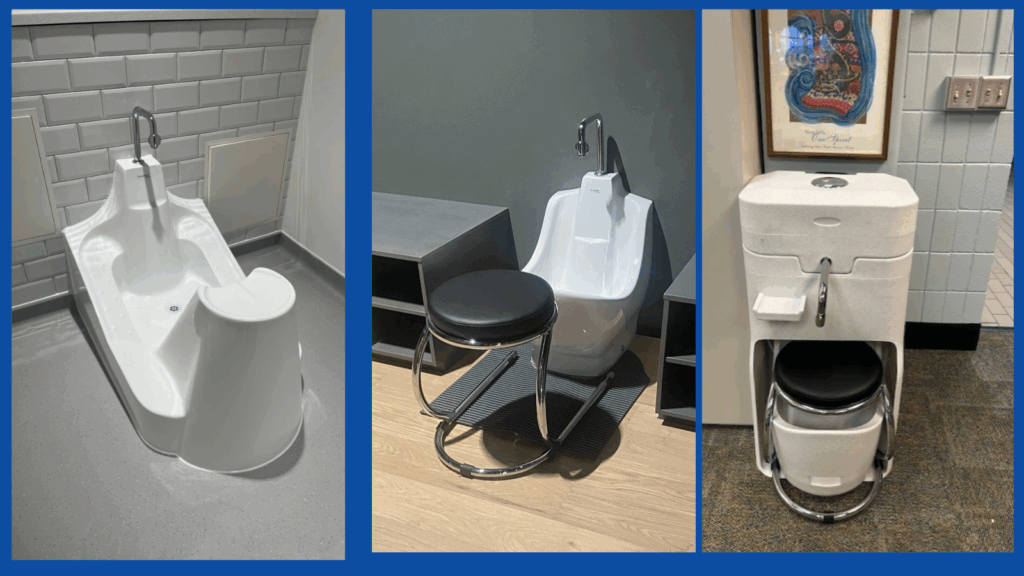
We offer a range of WuduMate units, so suit different users and environments. Some of these come with adjustable stools, and most of them have a range of tap options to suit the needs of different people.
Why It Matters: This ensures comfort for users of all sizes and abilities, including children, the elderly, and those with mobility challenges. Everyone can enjoy a comfortable and personalised wudu experience.
Splash-Free Taps
Many WuduMate units have been designed by our founder and these have been perfected and improved with specific design elements to minimise water splashing and spills. WuduMate branded taps have been designed specifically to work with the design features in the wudu sinks.
Why It Matters: This feature reduces splashing, minimises contact with dirty water on the floor and keeps the wudu area clean and efficient, enhancing the wudu ritual for everyone.

Comfortable Seating
Our ergonomically designed stools provide ample support during wudu, and are designed to tuck away neatly when not in use. Stool handles are available to assist sitting and standing for those with limited mobility
Why It Matters: Comfortable seating supports proper posture and makes extended use much more pleasant, ensuring a comfortable experience.
Easy Access and Use
We’ve designed the WuduMate Compact with accessibility in mind, including features that make it easy for everyone, including children, those with limited mobility and wheelchair users, to access and use the unit safely.
Why It Matters: This promotes inclusivity and ensures that everyone can perform wudu comfortably and independently.

Real-Life Benefits of Ergonomic Design
Enhanced Comfort: With features like adjustable stools and splash-free taps, WuduMate products make the wudu experience more enjoyable and less cumbersome.
Increased Accessibility: Our designs accommodate a wide range of users, including those with special needs, ensuring everyone can perform wudu with ease.
Cleaner Environment: Features that reduce water splashing help keep the area neat and hygienic, contributing to a more pleasant environment.
Incorporating ergonomic design into wudu units isn’t just about adding a few modern touches; it’s about enhancing the overall experience for everyone involved.
With WuduMate’s focus on interchangeable components, splash-free technology, comfortable seating, and easy access, you can transform your wudu space into a more comfortable, accessible, and efficient environment. These thoughtful features ensure that performing wudu is not only a smooth and pleasant process but also inclusive for users of all abilities.
Whether you’re updating an existing facility or designing a new one, considering ergonomics can make a significant difference in both functionality and user satisfaction. WuduMate is dedicated to offering solutions that meet these needs, making sure that your wudu experience is as comfortable and enjoyable as possible.
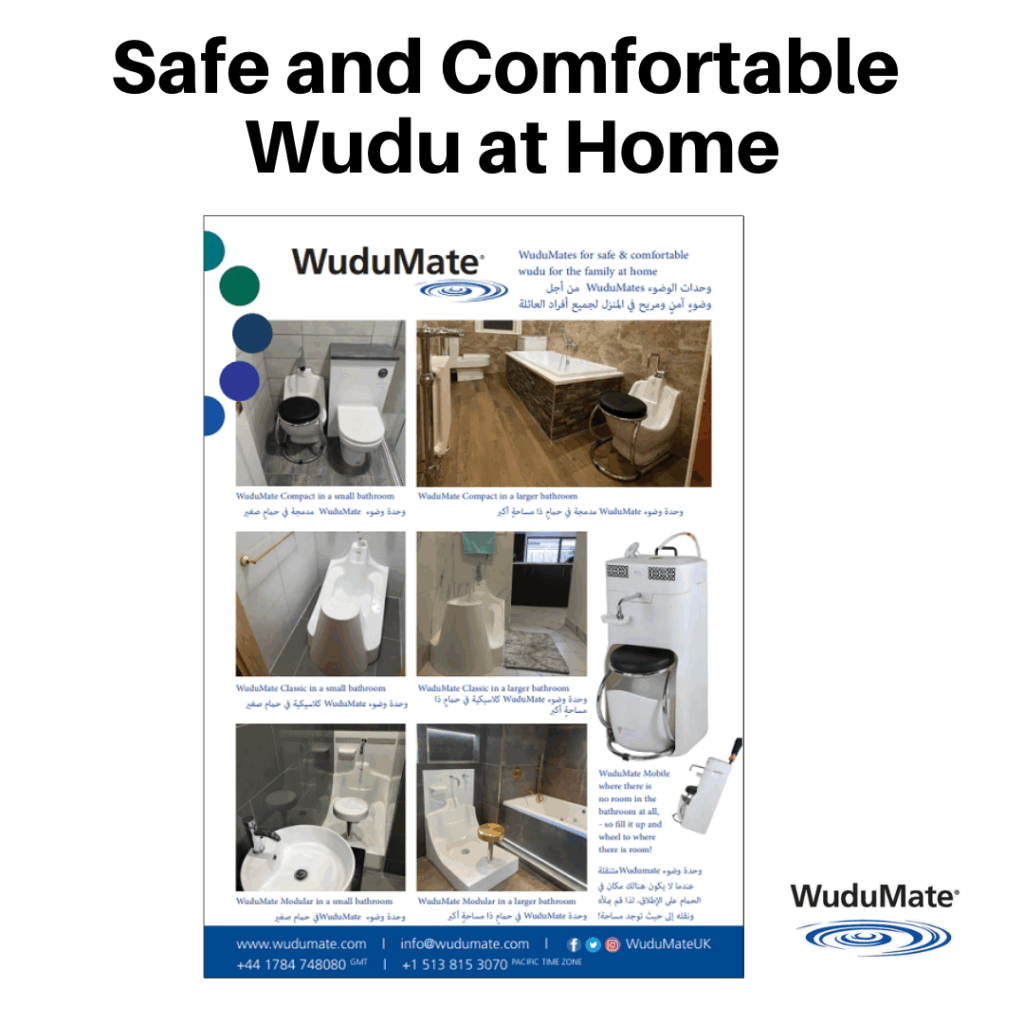
Explore our range of WuduMate products to see how ergonomic design can enhance your ablution area. To find out about the individual units pictuerd above, click on the relevant image.
If you have any questions or need personalised advice, feel free to get in touch. We’re here to help you create a wudu space that truly works for everyone.
“I didn’t always have a mineral water bottle to hand when I wanted to wash, and taking cups of water into a toilet is not always practical, so the WuduMate is ideal. It can be easily carried in your pocket or handbag, can hold a litre of water which is far more than the small water bottles which we normally use, and after use can be easily folded away again for use next time.”
WuduMate Testimonial – Community Masjid of Atlanta
We received this Testimonial from Imam Nadim Ali of the Community Masjid of the West End of Atlanta, Georgia.
We received this Testimonial from Imam Nadim Ali of the Community Masjid of the West End of Atlanta, Georgia.
The Masjid recently installed a series of WuduMate Modular units in their wudu area.
We received this Testimonial from Imam Nadim Ali of the Community Masjid of the West End of Atlanta, Georgia.
The Masjid recently installed a series of WuduMate Modular units in their wudu area.
“I didn’t always have a mineral water bottle to hand when I wanted to wash, and taking cups of water into a toilet is not always practical, so the WuduMate is ideal. It can be easily carried in your pocket or handbag, can hold a litre of water which is far more than the small water bottles which we normally use, and after use can be easily folded away again for use next time.”
5 Ways to make a Multi-Faith Workplace Work
Are you ready to unlock the full potential of your diverse workforce?
At WuduMate, we’re well aware of the challenges involved in creating an environment where everyone feels included and valued. We believe that embracing diversity isn’t just a box to tick – it’s the key to fostering innovation, boosting retention, and creating a workplace where every individual feels valued and respected.
Here are five powerful ways to transform your workplace into a vibrant hub of inclusivity:
1. Empower Through Education
Kickstart your journey towards inclusivity by emphasising the importance of diversity education. From frontline employees to top-level managers, Diversity training should be a compulsory training module across every organisation, ensuring all staff are able to apply inclusive principles to everything they do.
A good training programme should address all types of diversity, including race, culture and religion. It should teach employees how to embrace our differences and use them to create great work, and never to discriminate, judge or dismiss them.


2. Neutralise Bias in Recruitment:
Unconscious bias can unknowingly seep into the hiring process, hindering efforts to build a diverse team. Blind hiring techniques, neutral language in job descriptions, and objective criteria can ensure that every candidate has a fair chance can help to make sure that no biases creep into play.
3. Respect Religious Holidays:
Imagine a workplace where every employee feels empowered to celebrate their religious holidays without fear or hesitation. By honouring diverse religious observances and offering flexibility in time off, you demonstrate genuine respect for your team’s beliefs.
4. Inclusive Dress Codes:
When it comes to dress codes in the workplace, it’s essential for businesses to strike a balance between professionalism and inclusivity. While enforcing a dress code, whether it’s a uniform or not, is reasonable, accommodating religious garments can sometimes be challenging.
In the UK, employers are obligated to “reasonably accommodate” the beliefs and needs of their staff under the Equality Act 2010. However, there are instances where safety concerns may arise, such as in manual labour roles. In such cases, it may be necessary for employers to restrict certain items of clothing if they pose a health and safety risk.
The key to maintaining inclusivity and respect is to find a middle ground that prioritises both cultural diversity and workplace safety. By adhering to health and safety regulations while remaining open and accommodating to religious attire, businesses can foster an environment that embraces diversity while ensuring the well-being of all employees.

5. Multi-Faith Spaces for Spiritual Reflection:
As an employer, demonstrating a willingness to accommodate your employees’ religious beliefs and needs is paramount. Providing a designated space for prayer. meditation or reflection, is a tangible way to show support for diversity and inclusion in the workplace. Providing a segregated ablution area with appropriate washing appliances for male and female Muslims, who perform a ritual ablution practice called wudu before each of their prayers, will help to make the experience even more meaningful for those employees.
While it’s not a legal requirement, creating such a space aligns with best practices for fostering a truly inclusive multi-faith environment. In cases where space constraints limit the availability of a dedicated room, a viable compromise could involve scheduling specific times for prayer in a meeting room.
People of all religious faiths and none, may have their own preferences and requirements when it comes to the design of your wellbeing or multi-faith room. It’s a good idea to consult with a diverse sample of your staff at the planning stage, to discover what kind of space they would ideally like to see. We have listed some common things that people ask for in our booklet Diversity Matters – Guide to Best Practice Multi-Faith Room Design, which will help you with the design and specification process.
Conclusion
Embracing diversity not only enriches the workplace culture but also yields numerous benefits, including heightened innovation, improved retention rates, and enhanced employee satisfaction. To bridge the gap between HR managers’ perceptions of inclusivity and the actual beliefs of employees, proactive measures must be taken to ensure that all cultural values are acknowledged and respected in a professional manner.
If you’d like to explore how incorporating a WuduMate ablution appliance in your workplace can enhance inclusivity and accommodate the diverse religious needs of your workplace, don’t hesitate to get in touch with our team on +44 (0)1784 748080.
We’re here to provide guidance and support to help you create a truly inclusive environment where every one of your employees feels valued and respected.
“I didn’t always have a mineral water bottle to hand when I wanted to wash, and taking cups of water into a toilet is not always practical, so the WuduMate is ideal. It can be easily carried in your pocket or handbag, can hold a litre of water which is far more than the small water bottles which we normally use, and after use can be easily folded away again for use next time.”
The WuduMate WuduBasin is best suited for homes and small workplaces where there is insufficient space for a separate hand basin and footbath, but the users require a safer and more comfortable appliance in which to rinse their feet when performing wudu, rather than a hand basin or shower.
Download a pdf copy of the new brochure here (click the image)
Alternatively, contact our sales team to request a printed copy of the brochure or for any other enquiries you may have.

“It meant a lot to me to be able to comfortably pray as I was able to return to my desk reenergised and refocused which is one of the great benefits of the five daily prayers Muslims observe and therefore helped me feel so much more motivated. ”
WuduMate Exhibiting at LOHAS Expo in Hong Kong
We are proud to announce that WuduMate will be exhibiting its innovative wudu basins and ablution products in the halal pavilion at the LOHAS Expo in Hong Kong from Friday 26th – Sunday 29th January.
The South China Morning Post reports that the halal pavilion at this trade show is deliberately designed to make Hong Kong more attractive to Muslims.
We look forward to making new contacts and spreading the word about the benefits of having a multi-faith area in your workplace or public building, to business owners in Hong Kong.
Our founder and CEO Nigel Bromilow and his wife Annabel, can be seen on the back row of this picture, second and third from the right.

“It meant a lot to me to be able to comfortably pray as I was able to return to my desk reenergised and refocused which is one of the great benefits of the five daily prayers Muslims observe and therefore helped me feel so much more motivated. ”
What are the steps of Wudu and why is it performed?
If you are not Muslim, you may be curious about why your Muslim colleagues are asking for a place where they can wash themselves, including their feet, before prayer.
Muslims pray five times a day – the timings and the specific process for these prayers is set out in the Quran. Before each prayer, it is necessary to perform a pre-prayer ritual in order to be spiritually pure.
Wudu (or Wudhu) is an ablution or cleansing ritual that is an important part of purity and cleanliness in Islam. It follows a process to wash hands, mouth, nostrils, arms, face, ears, hair and feet. It prepares one mentally and physically ahead of prayer and must therefore be performed correctly.
Here are the steps of wudu – the process takes around three minutes.

Here is a video where you can see the process from start to finish.
You will see from this video, that it is much easier to perform wudu in a seamless flow from a seated position. In theory it is possible (although questionable for health and safety reasons), to perform wudu while standing at a handbasin, but the process will be much quicker and straightforward if there is a dedicated wudu footbath in the vicinity of where the prayers will be offered.
Ideally this facility should be out of sight of others, with a curtain or door to close it off – this will allow female Muslims to remove their hijab for the hair washing part of the ritual. If there are a large number of Muslims using the facility, a separate wudu area for men and women would be recommended.
If you are designing a multi-faith area in your facility, it is a good idea to consult with staff members in your organisation who would use the facility, to see what their requirements are. You can also download our free booklet: Diversity Matters: Guide to Best Practice Multi-Faith room design which covers the usual requests and requirements of people from different cultural and religious backgrounds.
We received this quote from a user of one of our office intallations:
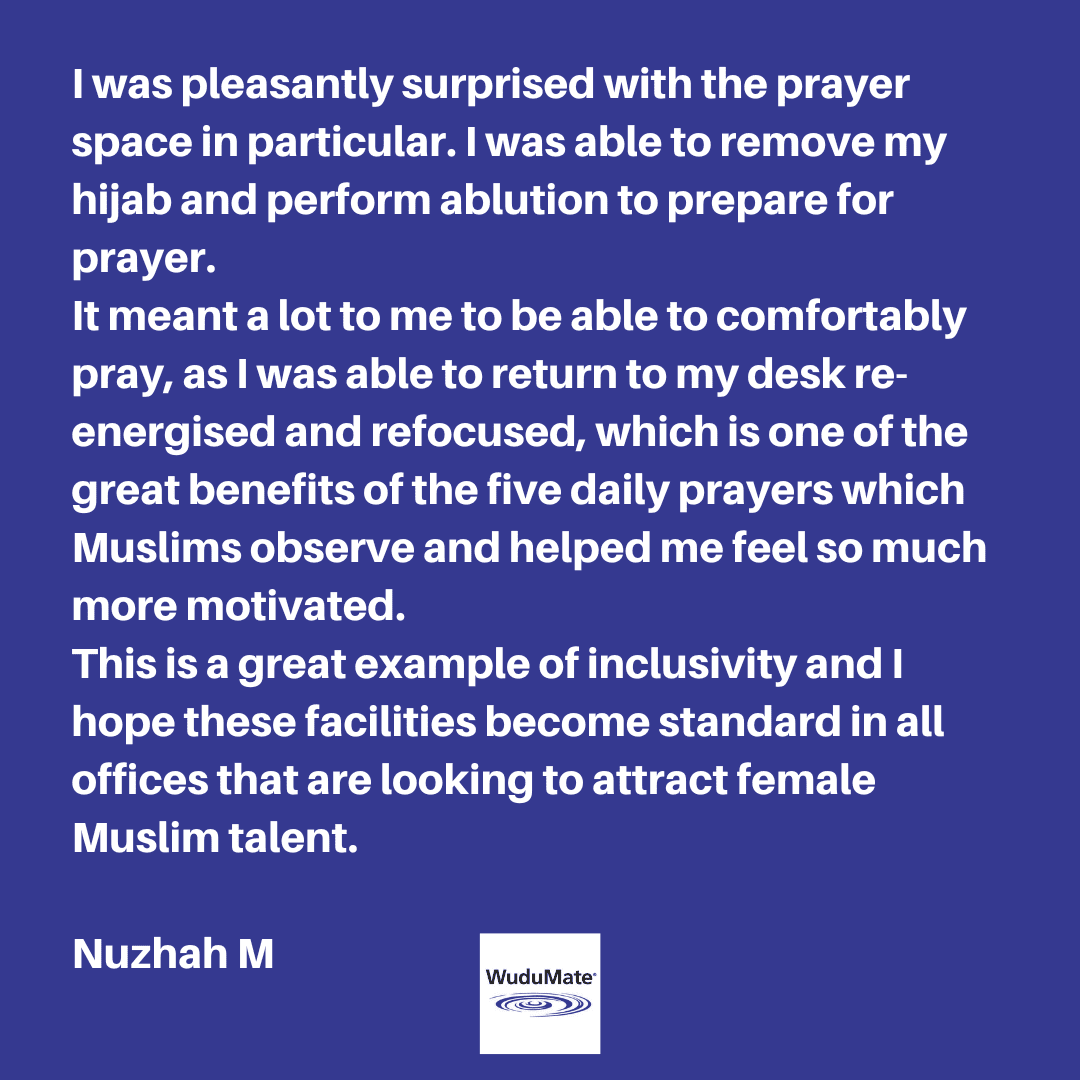
“The office has very impressive amenities, but I was pleasantly surprised with the prayer space in particular.
In my experience female prayer spaces have often felt like an afterthought. However at this office I was able to comfortably remove my hijab and perform ablution to prepare for prayer. This is something that I have to anticipate not being able to do before I leave the house, because sometimes Muslim prayer spaces don’t accommodate for women who wear hijab.
It meant a lot to me to be able to comfortably pray, as I was able to return to my desk reenergised and refocused, which is one of the great benefits of the five daily prayers Muslims observe and therefore helped me feel so much more motivated.
This for me is a great example of inclusivity and I hope that these facilities become a standard in all offices, especially by companies that are looking to attract female Muslim talent.”
If you have any questions or need some advice about the design of your multi-faith room please contact our team.
“I didn’t always have a mineral water bottle to hand when I wanted to wash, and taking cups of water into a toilet is not always practical, so the WuduMate is ideal. It can be easily carried in your pocket or handbag, can hold a litre of water which is far more than the small water bottles which we normally use, and after use can be easily folded away again for use next time.”
Answered Prayers: The Resurgence of Multi-Faith Spaces in the Workplace
The once-overlooked prayer room is making a comeback in British corporate life, evolving into sophisticated 'multi-faith spaces', wellness areas or 'mindfulness rooms'. These spaces are no longer mere afterthoughts, but integral components of workplace diversity and well-being. The resurgence is fuelled by businesses recognising the competitive advantage of catering to diverse religious needs. With the Muslim population in the UK doubling in the past decade, accommodating faith requirements has become a strategic imperative.
Organisations like Norton Rose Fulbright have long understood the value of multi-faith spaces. Lak Purewal, Head of HR, emphasises the practical benefits of a dedicated room, not only for employees but also for clients. These spaces serve as inclusive sanctuaries, fostering a sense of community and offering on-site solutions for religious practices.
Beyond religious accommodation, wellness rooms contribute to employee well-being, providing much-needed quietude for recharging. HR professionals recognise the importance of creating environments that cater to diverse needs, including those of introverts and neurodiverse people who thrive in more serene settings.
While some may question the compatibility of multi-faith rooms with profit-driven objectives, well-designed facilities not only mitigate stress and absenteeism but also contribute to a positive workplace culture.


Despite differing motivations for their creation, the prevalence of multi-faith rooms is undeniable. As they become commonplace in workplaces, the focus shifts to ensuring their quality and functionality. The University of Manchester’s research on multi-faith spaces underscores the nuanced relationship between sacred spaces and business objectives.
In conclusion, prayer and meditation facilities in workplaces are here to stay and will continue to shape conversations within HR and related communities. The challenge lies in making these spaces not only functional but also enriching experiences for all who use them.
As workplaces embrace the diversity and well-being benefits of faith spaces, the big question remains: How can we ensure these spaces are both enriching and functional?
At WuduMate, we have been helping corporate clients worldwide with the design and set up of multi-faith rooms for over 15 years. We pride ourselves on delivering tailored packages crafted to perfection. Our extensive selection of wudu appliances and accessories ensures that we have a wudu solution for every need, no matter how big or small the location is.
No-one does wudu like we do.
“I didn’t always have a mineral water bottle to hand when I wanted to wash, and taking cups of water into a toilet is not always practical, so the WuduMate is ideal. It can be easily carried in your pocket or handbag, can hold a litre of water which is far more than the small water bottles which we normally use, and after use can be easily folded away again for use next time.”
Performing Wudu using the WuduMate Modular
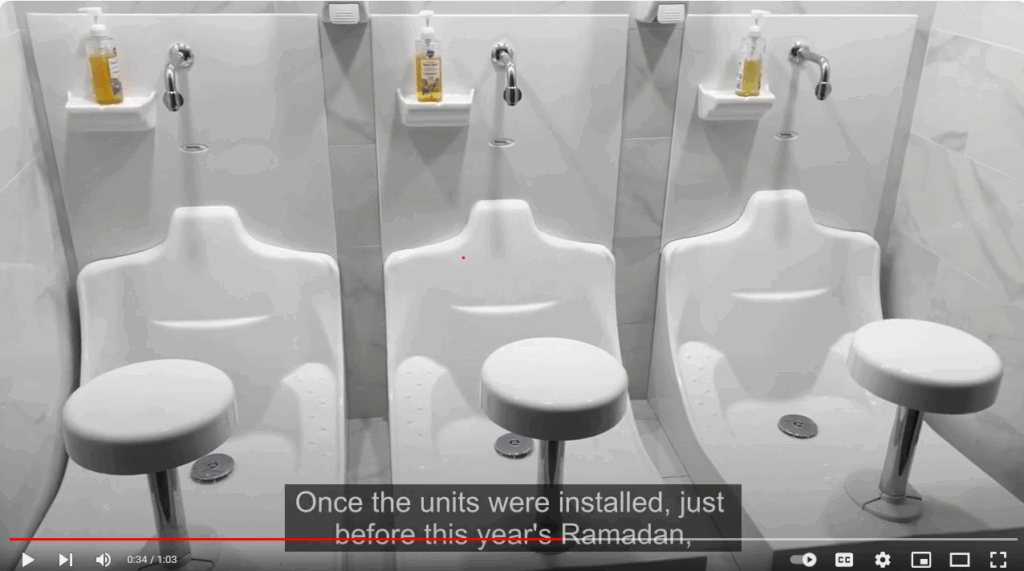
The video shows how easy and comfortable it is to perform wudu using the WuduMate Modular. The tap is at the correct angle to minimise splashing and there is a comfortable footrest to assist foot washing. Taps can be configured with a wrist blade or auto sensor to assist those with limited mobility.
This video shows the Wudumate Modular with a soap shelf, which can also be used to hold watches and other valuables. The Modular can also be configured with an inbuilt soap dispenser behind the back panel
The WuduMate Modular can also be configured without a seat, to allow wheelchair access or for those who prefer to perform wudu whilst standing. In a bank of WuduMate Modular units, you can specify how many of them have seats.
The seat tops and seat pole base covers come in a variety of colours and finishes to compliment your decor, and the units can be finished with co-ordinating vinyl decals.
Any Questions? Contact our Customer Services Team here
Information and Spec sheets for WuduMate Modular
“I didn’t always have a mineral water bottle to hand when I wanted to wash, and taking cups of water into a toilet is not always practical, so the WuduMate is ideal. It can be easily carried in your pocket or handbag, can hold a litre of water which is far more than the small water bottles which we normally use, and after use can be easily folded away again for use next time.”
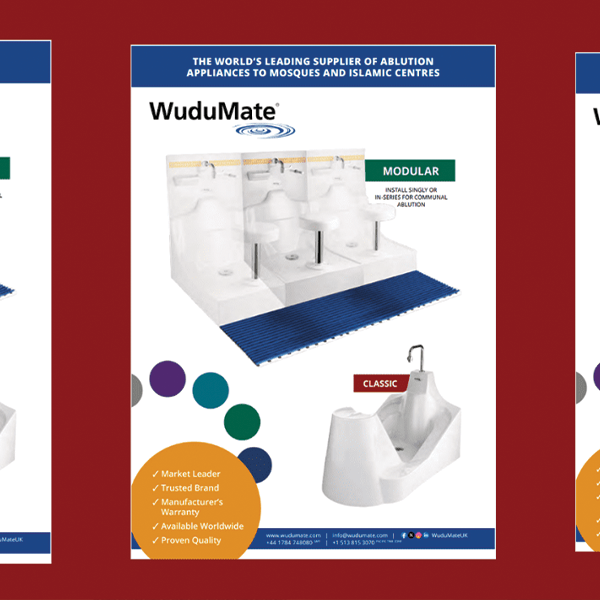
New WuduMate Brochure for Mosques
We have recently published a new WuduMate brochure, aimed specifically at those who are fitting out mosques, Islamic Centres, and similar ablution areas which are likely to have high traffic.
This brochure focuses on the WuduMate products which are most often chosen by our mosque customers, pointing out the features of each, with before and after photos to show how a refit can transform and enhance a busy wudu area.
You can download a pdf copy of the new Mosque Brochure by clicking here, or you can get a hard copy brochure by visiting our stand at Mosque Expo this Saturday, 25th November in Manchester.
If you would like us to post you a copy of the brochure and you cannot come to Mosque Expo, please fill in the Contact Form, indicating that you would like a Mosque brochure (or any other document) and including the name and address you would like the brochure to be sent to.

- Images of WuduMate Modular
- WuduMate Modular specifications
- Images of other models in mosques
- Any Questions? Contact the Sales Team
You may also enjoy these posts:
“I didn’t always have a mineral water bottle to hand when I wanted to wash, and taking cups of water into a toilet is not always practical, so the WuduMate is ideal. It can be easily carried in your pocket or handbag, can hold a litre of water which is far more than the small water bottles which we normally use, and after use can be easily folded away again for use next time.”
Diversity and Inclusion in Action at Elekta
We saw two lovely posts on LinkedIn this week which perfectly demonstrate the increase in staff morale and wellbeing that can happen when a company takes steps to make all members of staff feel welcome and included.
The management at Elekta in Crawley, had already provided a multi-faith room for their employees. However there wasn’t anywhere specific for the Muslim staff to perform the pre-prayer wudu ablution ritual.
One member of staff, Aisha Mehmood, describes how she used to perform wudu in the company shower facilities, but she frequently got her clothes wet, and the situation wasn’t ideal. So she did her research, and asked the management whether it would be possible to install a WuduMate ablution facility.
One of the management team, Tim, was very receptive to the idea and glad to be made aware of the issue, and he immediately began working on a solution.
Within a few weeks, they had identified a suitable location and Tim had arranged for a WuduMate Classic to be installed within a proper secluded room. Tim and his team also made sure that the WuduMate was accessible to all employees, regardless of their mobility needs as close as possible to the prayer room.

Aisha was very grateful for this considerate intervention:
After a period of leave I was thrilled to be back in the office today to find that we have a brand-new WuduMate installed. This is a device that allows Muslims to safely and easily perform ablution for their daily prayers.
I’m so grateful to Tim Rose CIWFM and to everyone else who was involved in making this possible. The installation of the WuduMate is a huge step forward for diversity and inclusion at Elekta and I’m proud to work for a company that is committed to making everyone feel welcome.
This wouldn’t have been possible without the encouragement and support of my fellow volunteers for the Diversity, Inclusion and Belonging group at Elekta who have been paramount in fostering a more inclusive workplace.
See Post on LinkedIn
Another Elekta employee, Mohid Waseem said:
I’m thrilled to share that Elekta Crawley has taken a significant step towards inclusivity by installing a WuduMate station. As a practicing Muslim, this makes me feel more included in the company, as it eliminates the awkwardness of performing pre-prayer ablution in public bathrooms.
Kudos to Aisha Mehmood and Tim Rose CIWFM for their dedication to making this happen. Their efforts reflect Elekta’s commitment to an inclusive workplace that respects the diverse needs of its employees.
This change reaffirms my pride in being part of Elekta, where diversity and inclusion are celebrated.
If you would like more information about WuduMate appliances, or the best way to furnish and set out a multi-faith space, so it can be enjoyed by people of all faiths and none, please take a look at the following:
“I didn’t always have a mineral water bottle to hand when I wanted to wash, and taking cups of water into a toilet is not always practical, so the WuduMate is ideal. It can be easily carried in your pocket or handbag, can hold a litre of water which is far more than the small water bottles which we normally use, and after use can be easily folded away again for use next time.”
WuduMate Exhibiting at BuildCon Bangladesh
We are pleased to announce that WuduMate will have a stand at BuildCon Bangladesh, which is taking place from 23rd to 25th November, 2023 at ICCB Exhibition Hall, Dhaka, Bangladesh.
The Bangladesh Expo was launched in the year 2015 and this is the 7th time it has taken place. The exhibition was initially intended to bring together architects and builders, contractors, engineers and civil engineers, fabricators, manufacturers, interior decorators, importers, dealers, distributors, traders, government departments, and other industry experts under one roof for displaying and sourcing products and services.
We are very much looking forward to meeting some of our contacts we have corresponded with for some time, and to making new connections in the area.

“I didn’t always have a mineral water bottle to hand when I wanted to wash, and taking cups of water into a toilet is not always practical, so the WuduMate is ideal. It can be easily carried in your pocket or handbag, can hold a litre of water which is far more than the small water bottles which we normally use, and after use can be easily folded away again for use next time.”
WuduMate exhibiting at Mosque Expo in November
We hare very happy to announce that WuduMate will once again be exhibiting at Mosque Expo on Saturday 25th November near Manchester.
Mosque Expo is a wonderful day out for adults and children alike, with lots to see and do for all the family. We are looking forward to meeting the people who have been nominated for this year’s Beacon Mosque Awards, and to meet some people who have not been able to attend the Expo when it was held near London.
You can apply for free entry tickets by clicking this link:

“I didn’t always have a mineral water bottle to hand when I wanted to wash, and taking cups of water into a toilet is not always practical, so the WuduMate is ideal. It can be easily carried in your pocket or handbag, can hold a litre of water which is far more than the small water bottles which we normally use, and after use can be easily folded away again for use next time.”
Diversity Matters and WuduMate Brochure now available in Japanese
Following a surge of interest for our products in Japan, you can now download Diversity Matters, our world-renowned Guide to Multi-faith Room Design, in a new Japanese language edition. We have also translated our sales brochure into Japanese.
日本での当社製品への関心の高まりを受けて、世界的に有名な多宗教向けの部屋設計ガイド『Diversity Matters』の新しい日本語版をダウンロードできるようになりました。販売パンフレットも日本語に翻訳しました。
「ドキュメント」の上の画像をクリックすると、これらのドキュメントのいずれかをダウンロードできます。印刷版が必要な場合は、お問い合わせください。

You can download either of these documents from this link – Japanese Language Documents, or if you would like a printed version or have any other questions please contact us.
“I didn’t always have a mineral water bottle to hand when I wanted to wash, and taking cups of water into a toilet is not always practical, so the WuduMate is ideal. It can be easily carried in your pocket or handbag, can hold a litre of water which is far more than the small water bottles which we normally use, and after use can be easily folded away again for use next time.”
WuduMate receives WaterMark Certification for Pillar tap and Wall-Mounted tap
We are very proud to announce that the WuduMate 1/4 turn Pillar and Wall-Mounted taps have been granted WaterMark Certification on 30th June 2023.
This enables us to offer WaterMark-compliant WuduMate solutions to commercial projects in Australia.
Click this image to view or download a pdf copy of the certificate.

WaterMark is a certification mark provided by independent certifying authorities. It confirms the product:
- complies with the Plumbing Code of Australia
- is fit for purpose
- meets relevant Australian Standards relating to product quality, including health and safety.
Certification is required before a licenced plumber can install plumbing products, in accordance with state and territory plumbing regulations.
This WaterMark Certification joins our CSA certification, and we strive to meet or exceed quality standards throughout the world.
Click here for more information about the WuduMate Taps which are now WaterMark Certified.
“I didn’t always have a mineral water bottle to hand when I wanted to wash, and taking cups of water into a toilet is not always practical, so the WuduMate is ideal. It can be easily carried in your pocket or handbag, can hold a litre of water which is far more than the small water bottles which we normally use, and after use can be easily folded away again for use next time.”
University of Oklahoma installs WuduMate Mobile in the washroom
We received a lovely testimonial from Mewbourne College of Earth and Energy, part of the University of Oklahoma. They created an ablution room and chose two WuduMate Mobile units to furnish it.
“Thank you for helping us at the University of Oklahoma (USA) to help our community. We have been very pleased with our WuduMate purchases, and they have a great deal of use each week.”

“I didn’t always have a mineral water bottle to hand when I wanted to wash, and taking cups of water into a toilet is not always practical, so the WuduMate is ideal. It can be easily carried in your pocket or handbag, can hold a litre of water which is far more than the small water bottles which we normally use, and after use can be easily folded away again for use next time.”
Diversity Matters 2023 update now available in French and German
The 2023 edition of our publication Diversity Matters – Guide to Best practice Multi-Faith room design is now available in French and German.
The latest version contains recent images of multi-faith room installations to give you inspiration, and builds on our 15 years of experience in this area. You will learn what people of different faiths might hope to find in a prayer and contemplation space, and how to best design the space so that it will be welcoming and harmonious for all users.
You can download this publication here – no email address required.
English – Diversity Matters
French – La Diversité est Importante
German – Vielfalt ist Wichtig

L’édition 2023 de notre publication Diversity Matters – Guide to Best practice Multi-Faith room design est désormais disponible en français et en allemand.
La dernière version contient des images récentes d’installations de salles multiconfessionnelles pour vous inspirer et s’appuie sur nos 15 années d’expérience dans ce domaine. Vous apprendrez ce que les personnes de différentes confessions pourraient espérer trouver dans un espace de prière et de contemplation, et comment concevoir au mieux l’espace afin qu’il soit accueillant et harmonieux pour tous les utilisateurs.
Français – La Diversité est Importante
Die Ausgabe 2023 unserer Publikation Diversity Matters – Guide to Best practice Multi-Faith room design ist jetzt auf Französisch und Deutsch erhältlich.
Die neueste Version enthält aktuelle Bilder von multireligiösen Rauminstallationen, um Sie zu inspirieren, und baut auf unserer 15-jährigen Erfahrung in diesem Bereich auf. Sie erfahren, was Menschen unterschiedlichen Glaubens von einem Gebets- und Kontemplationsraum erwarten können und wie Sie den Raum am besten so gestalten, dass er für alle Benutzer einladend und harmonisch ist.
Deutsch – Vielfalt ist Wichtig
“I didn’t always have a mineral water bottle to hand when I wanted to wash, and taking cups of water into a toilet is not always practical, so the WuduMate is ideal. It can be easily carried in your pocket or handbag, can hold a litre of water which is far more than the small water bottles which we normally use, and after use can be easily folded away again for use next time.”
WuduMate Classic units at Edgbaston Cricket Ground
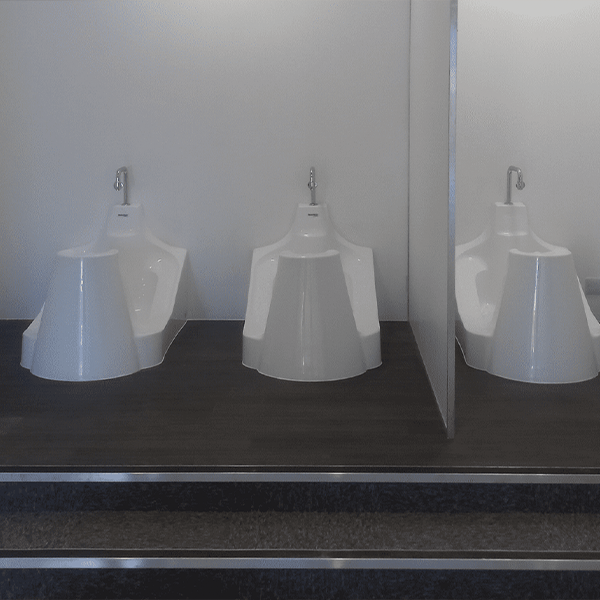
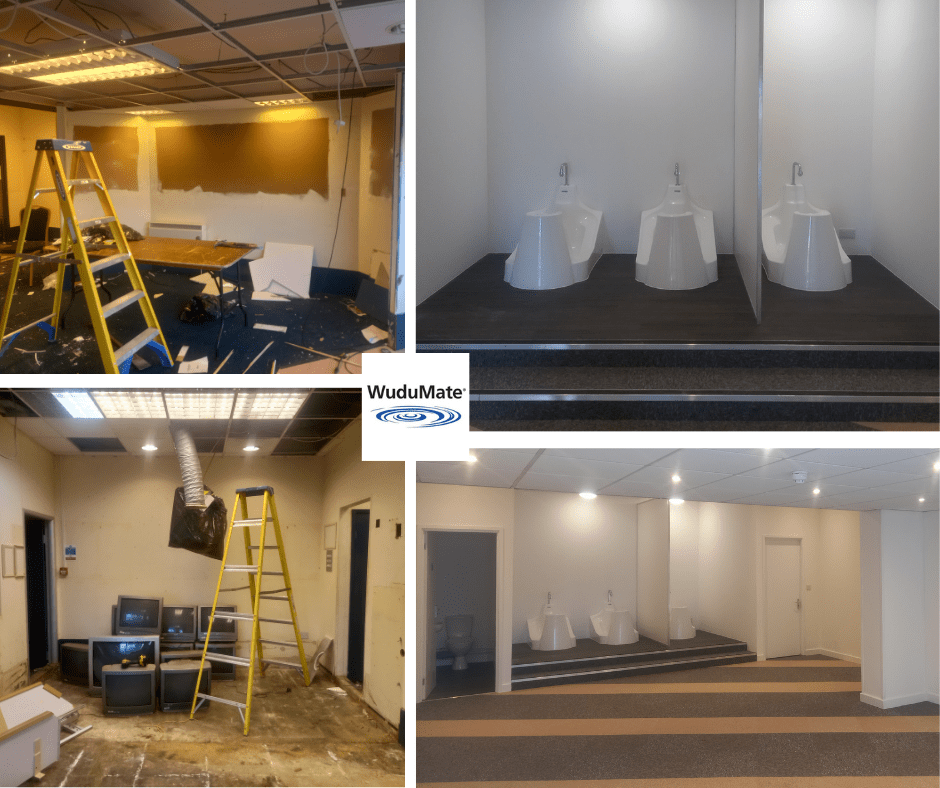
Edgbaston Cricket ground recently completed the refurbishment of a redundant bookmakers area, into a state of the art multi-faith and prayer room, including three WuduMate Classic ablution appliances, separated from the main prayer area by a raised platform.
The refurbishment works were done by Wycliff Services Ltd. who sent us these wonderful before and after pictures. I think you will agree that the transformation has been stunning.

WuduMate Personal
Edgbaston Cricket ground recently completed the refurbishment of a redundant bookmakers area, into a state of the art multi-faith and prayer room, including three WuduMate Classic ablution appliances, separated from the main prayer area by a raised platform.
The refurbishment works were done by Wycliff Services Ltd. who sent us these wonderful before and after pictures. I think you will agree that the transformation has been stunning.
It’s lovely to see that the Muslim community is enjoying the new facilities, as per this post on LinkedIn https://www.linkedin.com/feed/update/urn:li:activity:6952316026868924416/
We are very happy to see our products in more and more sports facilities up and down the country, and pleased to know that Muslims can enjoy watching and participating in sport, whilst still fulfilling their daily prayer and ablution requirements.
“I didn’t always have a mineral water bottle to hand when I wanted to wash, and taking cups of water into a toilet is not always practical, so the WuduMate is ideal. It can be easily carried in your pocket or handbag, can hold a litre of water which is far more than the small water bottles which we normally use, and after use can be easily folded away again for use next time.”
WuduMate makes donation to DEC Syria/Turkey Earthquake Appeal Fund
WuduMate recently had a stand at the Muslim Shopping Festival at the Excel Centre. We were selling our WuduMate Personals, with all proceeds going to the DEC Turkey/Syria Earthquake Appeal fund.
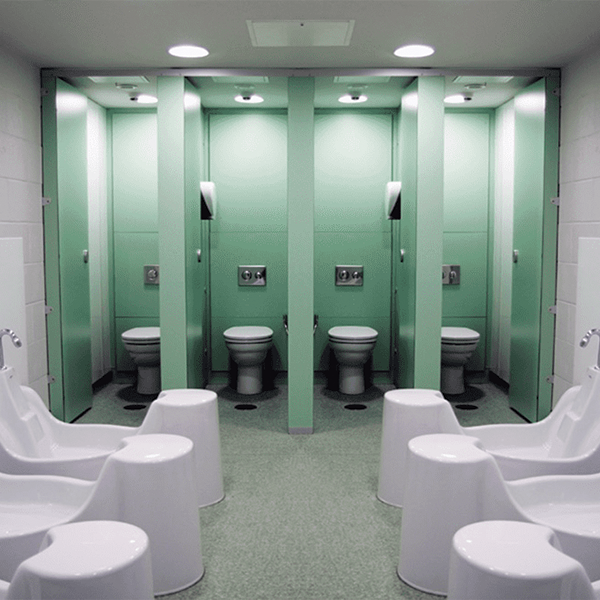
The WuduMate Personal is a foldable, pocket-sized ‘lota’ for personal washing (istinja), ideal for use when travelling away from home (e.g. school, university, work, umrah, hajj etc.).

WuduMate Personal
After deducting the VAT we made proceeds of £600, and our Managing Director Nigel Bromilow has made the donation to the DEC this week.

“I didn’t always have a mineral water bottle to hand when I wanted to wash, and taking cups of water into a toilet is not always practical, so the WuduMate is ideal. It can be easily carried in your pocket or handbag, can hold a litre of water which is far more than the small water bottles which we normally use, and after use can be easily folded away again for use next time.”
WuduMate at the London Muslim Shopping Festival
Win a WuduMate Compact – Enter below now or visit our stand at the London Shopping Festival
WuduMate will be exhibiting at this year’s London Muslim Shopping Festival, taking place at the Excel Centre on 25th-26th February. You will be able to ask us about our range of wudu sinks, perfect for your home, your workplace or your mosque
We will be selling our portable bidet or lota, the WuduMate Personal, and donating all proceeds from the sale of these to the Turkey Syria Earthquake Appeal.
We will also be giving away one of our popular WuduMate Compact ablution sinks to one lucky visitor.
You can enter this draw three ways, which you can access here – WuduMate Compact Giveaway


1: Submit your email address here (please note the winner will be informed by email so please accept to receive emails from WuduMate. You can unsubscribe from these once the giveaway is over)
2: Follow WuduMateUK on Facebook and/or Instagram (to enter using this method, you need to go to the online giveaway portal and tell us which address you have followed us with)
3: Post a selfie of yourself at the WuduMate stand at the London Muslim Shopping Festival and tag @WuduMateUK
We look forward to seeing you at the Muslim Shopping Festival – please stop by stand H36 and say hello.
“I didn’t always have a mineral water bottle to hand when I wanted to wash, and taking cups of water into a toilet is not always practical, so the WuduMate is ideal. It can be easily carried in your pocket or handbag, can hold a litre of water which is far more than the small water bottles which we normally use, and after use can be easily folded away again for use next time.”
New WuduMate Brochure for 2023 is now available
The 2023 WuduMate Brochure is now available to download. Click the image to download a pdf version of the latest brochure.
If you would like a hard copy of this brochure, our Diversity Matters booklet, or any other items from our Downloads page, please fill in this Contact form including your address, and we can send it to you.

“I didn’t always have a mineral water bottle to hand when I wanted to wash, and taking cups of water into a toilet is not always practical, so the WuduMate is ideal. It can be easily carried in your pocket or handbag, can hold a litre of water which is far more than the small water bottles which we normally use, and after use can be easily folded away again for use next time.”
The Oldest WuduMate User -100 year old Gentleman receives WuduMate Classic
Is this the oldest WuduMate user in the world?
Is this the oldest WuduMate user in the world?
This gentleman recently installed a WuduMate Classic in his home.
Our customer purchased this unit from us, and shipped it to his father’s house in Bangladesh, where they were doing renovations.
Now his elderly and esteemed grandfather can perform his pre-prayer ablutions in dignity and comfort.
Our customer told us: “My grandad in Bangladesh is 100 years old and still in good health, and he is really happy to see this. Loving the product!”

We love to hear people’s stories of using our products around the world. Please get in touch if you enjoy using our ablution sinks, wherever you are. And if you know of a WuduMate user that is older than this, please send us a photo and we will feature you. Until then, this gentleman takes the prize for the world’s oldest WuduMate user!
“I didn’t always have a mineral water bottle to hand when I wanted to wash, and taking cups of water into a toilet is not always practical, so the WuduMate Personal is ideal. It can be easily carried in your pocket or handbag, can hold a litre of water which is far more than the small water bottles which we normally use, and after use can be easily folded away again for use next time.”
WuduMate honours Excellence in Diversity and Inclusion at Business Awards
WuduMate sponsored the Ihsan Award for Excellence in Diversity and Inclusion at the Recent Islam Channel Business Awards held at the Hilton Metropole Hotel in London in November.
Five companies were nominated for this prestigious award; Blackburn Rovers Football Club, Deloitte, DLA Piper, EY, and KPMG, and the winner was Blackburn Rovers Football Club.

NIgel Bromilow gives a speech at the Islam Channel Business Awards
In his speech before presenting the award, our Managing Director Nigel Bromilow said how very important it is for companies in the UK today to take into account of the needs of staff, visitors and customers from other cultures.
Blackburn Rovers has introduced a number of new initiatives at their ground in recent years, including a multi-faith room, halal food and alcohol-free bars, as well as Diwali celebrations and Eid prayers on the pitch.

Yasir Sufi, Rovers’ Integration and Development Manager, said:
“Because of the work Blackburn Rovers has done over the past 18 months, not only our local Muslim community, but also the Muslim community around the world, knows that every football club should be open for them, should be welcoming to them and should make the provisions where Muslims can observe their prayers, have access to halal food and have access to facilities that are inclusive.”
I can’t thank enough all of the team at Blackburn Rovers, from our senior management all the way down to every member of staff, who prioritises this every day in what they do.”

“I didn’t always have a mineral water bottle to hand when I wanted to wash, and taking cups of water into a toilet is not always practical, so the WuduMate is ideal. It can be easily carried in your pocket or handbag, can hold a litre of water which is far more than the small water bottles which we normally use, and after use can be easily folded away again for use next time.”
WuduMate Commercial installed in Birmingham secondary school
This Birmingham secondary school was situated in an area of higher population density and higher percentage of ethnic minorities than the city averages. At the time, it was seeing good academic progress from the pupils, and this has continued in more recent years.
The improvement in academic performance was accompanied by an extensive refurbishment program. During this process, one of the new initiatives included the redevelopment of the ablution facilities – an area used by Muslim students before prayer. Another initiative was a redesign of the toilet areas to combat bullying.

For the ablution areas, project managers Lendlease suggested installation of WuduMate washing appliances specifically designed for Wudu. After advice from the manufacturer a series of WuduMate Commercial units was chosen, this model having already been successfully implemented in hundreds of similar environments. Eight units were installed in the male ablution area and four in the female facility.
“We were keen to adopt a long-lasting solution using latest generation materials to facilitate cleaning and reduce maintenance” said the project manager. “The WuduMate has proved to be far easier to implement that the construction of a traditional tile and cement trough and is being well received by those using it.”
The deputy head teacher was delighted with the decisions to install WuduMate ablution appliances and to create more open plan toilet areas, saying that staff and students alike were showing pride in the new facilities and feeling that the school had set a standard for others to follow.

The WuduMate Commercial was one of our original WuduMate footbaths, designed by our founder Nigel Bromilow.
We no longer sell this model – it has been superseded by the WuduMate Classic, an improved footbath design, updated after feedback from our users.
“I didn’t always have a mineral water bottle to hand when I wanted to wash, and taking cups of water into a toilet is not always practical, so the WuduMate is ideal. It can be easily carried in your pocket or handbag, can hold a litre of water which is far more than the small water bottles which we normally use, and after use can be easily folded away again for use next time.”
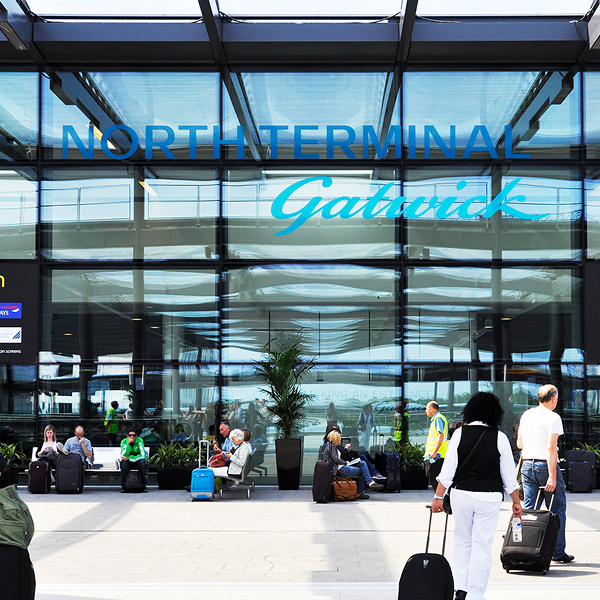
WuduMate Commercial Installation in Gatwick Airport Chapel
Located just south of Central London in the United Kingdom, Gatwick Airport has been in use since the late 1920s. Passenger numbers reached a peak of 46.6 million in 2019. At the time of the WuduMate project in 2013 there were already more than 34 million passengers passing through the airport on their way to over 190 destinations with more than 70 different airlines.
With a chaplaincy team in place since 1974 and a chapel opened two years later, Gatwick Chaplaincy has been serving tourists, business travellers and Gatwick Airport’s own staff for well over 35 years. Now very much a multi-faith chaplaincy, the move to provide inclusive facilities for practising one’s faith was spearheaded by Anglican chaplain Canon Jonathan Baldwin.
Through his many conversations with Muslim colleagues and chapel visitors over the years Canon Baldwin became aware of a need for suitable Wudu facilities.

A contractor was appointed to develop a new multi-faith area in the South Terminal and, with direction from the chaplaincy team, installed the WuduMate Commercial to support the airport’s Muslim staff and visitors. The contractor found it was the most appropriate solution on the market – easy to install and no need to dig into the floor slab to accommodate a tile and cement trough. With the completion of this project, Gatwick airport was now clearly capable of welcoming and accommodating ever-increasing diversity in its passengers and personnel.
“The general feeling was that the Wudu facilities would be popular, but until Hajj, we didn’t really appreciate how much they were needed,” said Canon Baldwin.
Footfall into the chapel was much increased and a further multi-faith room was later opened in the North Terminal.

The WuduMate Commercial was one of our original WuduMate footbaths, designed by our founder Nigel Bromilow.
We no longer sell this model – it has been superseded by the WuduMate Classic, an improved footbath design, updated after feedback from our users.
“I didn’t always have a mineral water bottle to hand when I wanted to wash, and taking cups of water into a toilet is not always practical, so the WuduMate is ideal. It can be easily carried in your pocket or handbag, can hold a litre of water which is far more than the small water bottles which we normally use, and after use can be easily folded away again for use next time.”
WuduMate to present an award at the Islam Channel Business Awards 2022
We are very proud to be sponsoring the Ihsan award for Excellence in Diversity and Inclusion at this year's Islam Channel Business Awards.
The Islam Channel Business Awards were due to take place in 2020, but were postponed for two years because of the pandemic. They offer a place to celebrate the best of Muslim entrepreneurial talent.
There are 15 original awards, which companies were nominated for in 2020. The list is below, and you can see the companies and individuals which have made the final for each award here.

The awards ceremony will be hosted by the BBCs Asad Ahmad.
- Start-up Business of the Year
- Family Business of the Year
- Micro Business of the Year
- Small Business of the Year
- Medium Sized Business of the Year
- Technology Business of the Year
- Food and Beverage Business of the Year
- Travel and Tourism Business of the Year
- Professional Services Business of the Year
- Fashion Business of the Year
- Businessman of the Year
- Businesswoman of the Year
- Financial Services Business of the Year
- Real Estate Business of the Year
- Community Business of the Year
New Awards this year
The Ihsan award for Excellence in Diversity and Inclusion is one of three new awards being presented for the first time at this year’s ceremony – as a result it is one of the awards that is still accepting nominations up until Friday 14th October.
Ihsan is an Arabic term for excellence; for doing something in the best way possible. This is a special award, open to any non-Muslim business which makes Muslims feel genuinely welcome by ensuring that they are included in all aspects of business life.
At WuduMate we feel passionate about this mission. For the last 15 years, we have been assisting businesses, and the managers and designers of public buildings, with multi-faith spaces, and how they can be designed and fitted out in a way to make the daily Muslim pre-prayer ritual as comfortable and convenient as possible.
As our founder Nigel Bromilow said “WuduMate would certainly have entered this new award in 2022, but it is a great honour to be asked to present it to another company that is joining us on this path.”
The other new awards that are still open for nominations are as follows:
Rising Star Business Award
This award is for businesses founded since 2019 or born from the pandemic.
Resilience Business Award
An award for businesses that have demonstrated resilience and innovation during the pandemic
You can nominate a business for one of the three new awards by filling in the Nomination Form on or before Friday October 14th 2022.
We are very much looking forward to attending the Islam Channel Business Awards ceremony, to meeting the inspirational Muslim business leaders of our time, and celebrating those businesses who are joining us in trying to make the business world a better place for Muslims.
“I didn’t always have a mineral water bottle to hand when I wanted to wash, and taking cups of water into a toilet is not always practical, so the WuduMate is ideal. It can be easily carried in your pocket or handbag, can hold a litre of water which is far more than the small water bottles which we normally use, and after use can be easily folded away again for use next time.”
Wudumate Ablution Facility at Royal Cornwall Hospitals NHS Trust
The Royal Cornwall Hospitals NHS Trust is the principal provider of acute care in Cornwall. It serves a population of around 430,000 people, a figure which is greatly increased by holidaymakers during the summer months.
The Royal Cornwall Hospitals NHS Trust employs approximately 5,000 staff with a mix of ethnicities and is committed to providing the best possible facilities in order to attract and retain its highly skilled teams of doctors, nurses and other health professionals.

A facility valued by the Trust’s Muslim staff is the purpose built WuduMate ablution facility provided by the Chaplaincy. It was specifically designed to enable Muslims to undertake their Wudu washing ritual before prayer in a safe, comfortable and dignified environment.
Before installation of the WuduMate, the only facilities for washing were inadequate and not considered suitable by the Trust for its staff.
The WuduMate ablution facility is available for all to use, including visitors and patients, although has predominantly been used by staff.
The Trust’s Lead Chaplain Reverend Mark Richards was delighted with the feedback he received. “With the addition of the WuduMate we can now offer 21st Century facilities for one and all. We have received a positive reaction from everyone concerned. Undoubtedly the facility is a tremendous enhancement to the spiritual centre of the Trust” he said at the time.
A Muslim doctor expressed his gratitude to the Trust for providing the WuduMate and the local MP until 2019, Sarah Newton, was also impressed. She said “It’s important that we recognise the ethnic mix of the population…and the multi-faith facility in the Royal Cornwall demonstrates excellently how appropriate facilities can easily be provided.”
Visit website: www.rcht.nhs.uk

“I didn’t always have a mineral water bottle to hand when I wanted to wash, and taking cups of water into a toilet is not always practical, so the WuduMate is ideal. It can be easily carried in your pocket or handbag, can hold a litre of water which is far more than the small water bottles which we normally use, and after use can be easily folded away again for use next time.”
WuduMate Compact installation in Canary Wharf Financial Institution
The London office of a leading blue-chip US based financial institution extended its multi-faith facilities in two Canary Wharf buildings to include ablution appliances specifically designed for Muslims to perform their pre-prayer wudu washing ritual.
The two buildings were managed by Norland Managed Services, a leading provider of managed building services in the UK. Norland’s Property Manager at that time was becoming increasingly concerned about the health and safety implications of water being spilt in the washrooms servicing two of the trading floors.

He realised that some of the issues identified in the WuduMate publication Diversity Matters, a Guide to Best Practice Multi-Faith Room Design, could well be the cause of the high level of water spillage.
After a consultation process between Norland and a group of their client’s Asian staff, it soon became clear that whilst multi-faith rooms had already been established in each building, they had not been equipped with appropriate washing facilities for those Muslims wishing to undertake their daily prayer ritual which included the washing of their feet.
Norland’s mechanical and electrical contractor was asked to contact The Specialist Washing Company, now trading as WuduMate, and after considering the various options, chose the WuduMate Compact ablution appliance, as the most appropriate foot-washing appliance for the limited space available.

Norland’s Property Manager said

Ismail Mahmood is a regular visitor to the Multi-Faith Room in his building and adds
“I didn’t always have a mineral water bottle to hand when I wanted to wash, and taking cups of water into a toilet is not always practical, so the WuduMate is ideal. It can be easily carried in your pocket or handbag, can hold a litre of water which is far more than the small water bottles which we normally use, and after use can be easily folded away again for use next time.”
WuduMate Classic installed at HM Prison, Buckley Hall
Buckley Hall was the fourth contracted out prison in the UK, and the first privately managed Category C establishment holding medium security prisoners. Originally a men’s prison, it changed to a closed female training prison in 2002. Three years later the decision was made to revert Buckley Hall to a male Category C prison, with the new prisoners beginning to arrive on December 5th, 2005.
It was recognised at this time that within the male prisoner population there would be a higher percentage of Muslim prisoners than had been the case when Buckley Hall had been a female establishment. An increased Muslim inmate population would require improved facilities for obligatory ablution before prayer to avoid both the otherwise inevitable water spillage and the misuse of and potential damage to basins not designed for this ablution ritual.
Buckley Hall has a diverse, multi-faith chaplaincy team providing services and support to prisoners. As a specialist manufacturer of prayer room and Wudu facilities, The Specialist Washing Company now trading as WuduMate were asked for their advice by the prison Chaplain, following recommendation by another HM Prison.

It was subsequently decided to install a WuduMate ablution appliance within the multi-faith chapel. This range of appliances are specifically designed to accommodate Wudu without spillage or waste of water, thus avoiding the health and safety issues associated with prisoners having to wash their feet in washbasins or other unsuitable receptacles. The prison facilities department also chose an electronic automatic tap unit so that water would be automatically dispensed when required, negating the need for accessories which could be easily damaged.
The chaplain at the time said that the ablution appliance had been successfully operating since installation and well received by inmates. It had negated the need to make use of unsuitable receptacles for Wudu, enabling quick and effective ablution. He thought it had proved to be a robust and secure device, ideally suited to the environment, with no cavities in which to secrete illegal items or substances. Its high-quality appearance was thought to contribute to respectful use by the inmates and he was hopeful that this would help minimise the incidence of misuse and damage in the future.
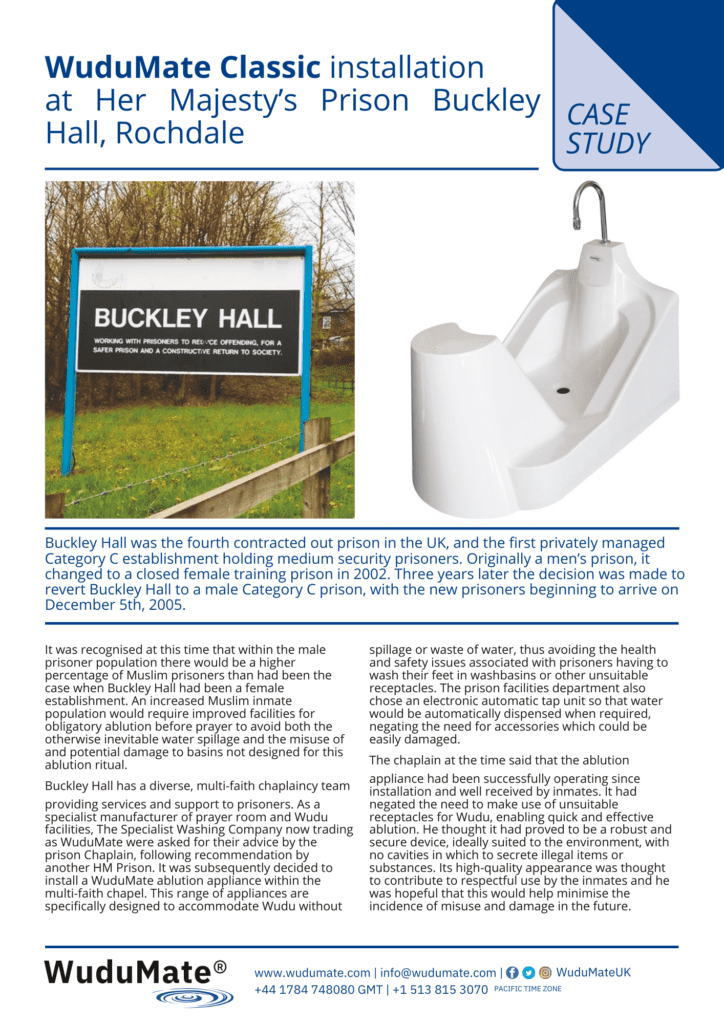
“I didn’t always have a mineral water bottle to hand when I wanted to wash, and taking cups of water into a toilet is not always practical, so the WuduMate is ideal. It can be easily carried in your pocket or handbag, can hold a litre of water which is far more than the small water bottles which we normally use, and after use can be easily folded away again for use next time.”
WuduMate Compact Series installed in Birmingham Primary School
Located in Small Heath, an area of Birmingham where around 70% of the population is Muslim, this school had a young and enthusiastic team and colourful and vibrant décor throughout.
The school was committed to an environment where bullying is seen by all to be unacceptable and where courtesy and good manners are promoted. Responsible behaviour was expected, and achievements recognized with awards and certificates.
As in the surrounding area, the school population was predominantly Muslim, and it was recognised that there were inadequate facilities in which Muslim pupils could perform their ritual ablution before prayer. The site manager at the time Gulfor Khan was tasked with assessing the situation.

”We realized that we had insufficient Wudu facilities for the many Muslim pupils within the academy, and so identified several areas with sufficient space and access to plumbing and drainage. Our next challenge was to identify suitable appliances for each location, and fortunately we were introduced to the WuduMate range by another local school who had recently undertaken a similar project. The WuduMate range consists of several models, giving us the flexibility to choose appliances to suit both the application and the spaces we had available.”
A local plumbing contractor was appointed to undertake the installation of a series of WuduMate Compact ablution appliances in the boys’ and girls’ changing rooms.
Gulfor Khan added:
“The Specialist Washing Company (now trading as WuduMate), reacted quickly so we could undertake the installation over half term, and met with the contractor on site to help determine the most appropriate WuduMate models to use.”
The subsequent installation proved to be a great success, with the WuduMate Compacts being excellently received by all who used them.
“I didn’t always have a mineral water bottle to hand when I wanted to wash, and taking cups of water into a toilet is not always practical, so the WuduMate is ideal. It can be easily carried in your pocket or handbag, can hold a litre of water which is far more than the small water bottles which we normally use, and after use can be easily folded away again for use next time.”
National Inclusion Week 2022: The Power of Now
National Inclusion Week is an annual event organised by Inclusive Employers, aimed at raising awareness of good practice in Diversity and Inclusion. This year's theme is The Power of Now.
At WuduMate we have been assisting employers for over 15 years, to understand the cultural and religious requirements of their employees, and to design and fit multi-faith areas, that meet the needs and preferences of those people who are likely to use them.
Our booklet Diversity Matters – a Guide To Best Practice Multi-Faith Room Design is freely available on our website, click the image below for an instant download.
This booklet condenses everything that we have learned about the religious needs and preferences of many diverse groups – what they would ideally like to find in a multi-faith area, and also things that they would prefer not to see, which might render the space uncomfortable for them.
Why is it important to cater for your employees’ religious and spiritual needs?
If you don’t practice a religion yourself, you might find it hard to imagine why a religious person needs to worry about their religion while they are at work. Many people feel that religion has no place in the workplace.
To be honest, many religious folk would agree with this opinion – they certainly do not want to cause any fuss, or to make an issue of their religion, and they really do want to keep it mainly personal. They only ask that they may have some time to pray or contemplate each day – just a few minutes.
This is particularly important for devout Muslims, who should pray (perform salat) five times a day, and it is thus likely that one or more of these prayers will be required to take place during working hours. Muslims are also required to perform ‘wudu’ before salat, a washing ritual which involves washing the face, hands, arms and feet before each prayer.
Most other religions do not have a daily prayer requirement, but some people may still wish to visit a ‘quiet’ space, whether to read a religious publication, or just to find solace for a while as a break from a busy work schedule. Some may have suffered a bereavement, or might want to ‘just take five minutes’ in the midst of a stressful working day.
In such a way, a multi-faith room is sometimes referred to as a ‘quiet room’, and as such is a useful resource for all members of the workplace community, irrespective of religion.
What are the benefits to the company?
We have seen lots of testimonials on social media from people expressing their gratitude that their spiritual needs were being met at work. These posts are being liked, shared and commented on by thousands of others.
Taken all together, it would seem that the main benefits to a company of providing a multi-faith area, are an increase in staff morale and productivity, and for the company to get a reputation as a good place to work.
Here are some examples, with links to the full post on social media. Wouldn’t it be good if your employees talked openly about your company this way?
“This is the best prayer facility that I’ve had! Thank you Amazon London!
A dedicated ablution room with towels for drying and a large comfortable prayer room with huge windows. These make me feel like my needs as a Muslim are acknowledged, understood, accepted and cared for.
It’s things like this thoughtful set-up that go towards making workplaces inclusive and accessible.”
https://www.linkedin.com/in/atikahamalina/
This post received 7,068 likes, 177 comments and 107 shares
“Some of you may know that Muslims wash their hands and feet before praying which is always a pain to do in western countries. So I was amazed to notice these beautiful Ablution seats at one of Microsoft’s newly refurbished buildings #inclusivitythroughaction.”
Humayun R
https://www.linkedin.com/posts/humayunr
This post received 96,327 likes and 1,743 shares – comments are turned off
“BT’s office has very impressive amenities, but I was pleasantly surprised with the prayer space in particular.
I was able to comfortably remove my hijab and perform ablution to prepare for prayer.
It meant a lot to me to be able to comfortably pray, as I was able to return to my desk re-energised and refocused, which is one of the great benefits of the five daily prayers which Muslims observe and helped me feel so much more motivated.
This for me is a great example of inclusivity, and I hope these facilities become standard in all offices that are looking to attract female Muslim talent.”
Nuzhah M
https://www.linkedin.com/posts/nuzhahmiah
“We love to see religious inclusion and that is what I found at Sky today.
They built an ablution room, a wet room where Muslims can comfortably make wudhu, without making a mess in the bathrooms.
I love it when an employer REALLY acknowledges and supports their employees.”
Mubina K
https://www.linkedin.com/posts/activity-6961006991603290112-N_k1
Conclusion
The provision of a suitable prayer room and amenities, can really improve staff morale, and can make a huge difference in the lives of your employees.
Our booklet Diversity Matters will help you to design and specify a space that will work well for people from all cultures.
“I didn’t always have a mineral water bottle to hand when I wanted to wash, and taking cups of water into a toilet is not always practical, so the WuduMate is ideal. It can be easily carried in your pocket or handbag, can hold a litre of water which is far more than the small water bottles which we normally use, and after use can be easily folded away again for use next time.”
Diversity and Inclusion in action at Sky
Another lovely testimonial demonstrating excellent diversity and inclusion practices in the corporate sector. We are so glad to be able to help companies like Sky provide an inclusive and welcoming environment for their employees. They have installed three WuduMate Compact units with soap dispensers.
We love to see religious inclusion and that’s what I found at Sky today.
As you know Muslims pray whilst at work, so Sky built an ablution room!
Using WuduMate, they have a dedicated wet room where Muslims can comfortably make wudhu, without making a mess in the bathrooms.
I love it when an employer REALLY acknowledges and supports their employees!

If you are planning a project of this nature, please take a look at our projects and our publication:
“I didn’t always have a mineral water bottle to hand when I wanted to wash, and taking cups of water into a toilet is not always practical, so the WuduMate is ideal. It can be easily carried in your pocket or handbag, can hold a litre of water which is far more than the small water bottles which we normally use, and after use can be easily folded away again for use next time.”
BT installs WuduMate Modular units in new London Head Office
BT opened a new London Head Office, known as One Braham in November 2021, housing around 3,500 employees.
We were delighted to see this photo and testimonial on LinkedIn from Nuzhah Miah, who had occasion to visit the building recently. She took the photo below and had this to say about her experience:
“The office has very impressive amenities, but I was pleasantly surprised with the prayer space in particular.
In my experience female prayer spaces have often felt like an afterthought. However at One Braham I was able to comfortably remove my hijab and perform ablution to prepare for prayer. This is something that I have to anticipate not being able to do before I leave the house, because sometimes Muslim prayer spaces don’t accommodate for women who wear hijab.
It meant a lot to me to be able to comfortably pray as I was able to return to my desk reenergised and refocused which is one of the great benefits of the five daily prayers Muslims observe and therefore helped me feel so much more motivated.
This for me is a great example of inclusivity and I hope that these facilities become a standard in all offices, especially by companies that are looking to attract female Muslim talent.”
Nuzhah Miah
We are very pleased to see that our appliances are being used and appreciated by the Muslim community.

photo credit Nuzhah Miah
“I didn’t always have a mineral water bottle to hand when I wanted to wash, and taking cups of water into a toilet is not always practical, so the WuduMate is ideal. It can be easily carried in your pocket or handbag, can hold a litre of water which is far more than the small water bottles which we normally use, and after use can be easily folded away again for use next time.”
WuduMate featured in Royal Institute of British Architects publication
We are very pleased that WuduMate products have been featured in the latest edition of RIBA – The List.
This publication from the Royal Institute of British Architects, is a directory of Chartered Architect practices in the UK.

“I didn’t always have a mineral water bottle to hand when I wanted to wash, and taking cups of water into a toilet is not always practical, so the WuduMate is ideal. It can be easily carried in your pocket or handbag, can hold a litre of water which is far more than the small water bottles which we normally use, and after use can be easily folded away again for use next time.”
Prayer and Wudu Facilities at External Events
This article is an extract from our booklet Diversity Matters – Guide to Best Practice Multi-Faith Room Design.
This article is an extract from our booklet Diversity Matters – Guide to Best Practice Multi-Faith Room Design. To download a pdf copy of the full booklet, please click the image below
It can be difficult to equip events such as seminars, weddings, festivals and exhibitions with appropriate prayer and washing facilities for Muslim guests, since this is likely to involve a temporary high level of demand. However, there is a huge amount of goodwill to be gained if you can try to meet the spiritual needs of your guests while they attend your event.
Allocating a space for prayer can be relatively easy in a commercial environment, either to be left as a dedicated space for Salat for the duration of the event, or used at other times for something else, and space cleared/chairs moved etc specifically for Salat when required.
If you are setting up a temporary prayer area for guests including Muslims, please take a look at our article on Tips for Setting up a Prayer room, to ensure that your space is fit for purpose – alternatively download the guide above as it will give you hints and tips to make the space as comfortable and amenable as possible.
To download a pdf copy of the full booklet, please click the image above
Provision for Wudu
Making suitable provision for ablution before prayer (Wudu) can be more difficult, because the only, likely, existing space with running water suitable for wudu, would be the washrooms; this will require visitors to wash their feet in washbasins, which is not recommended, and also not popular with Health & Safety officials.
There are some temporary wudu facilities provided by WuduMate, which can be considered, and this specialist company can also provide personal bidets for visiting Muslims to use after visiting the toilet to perform ‘Istinja’, another ablution requirement before prayer.
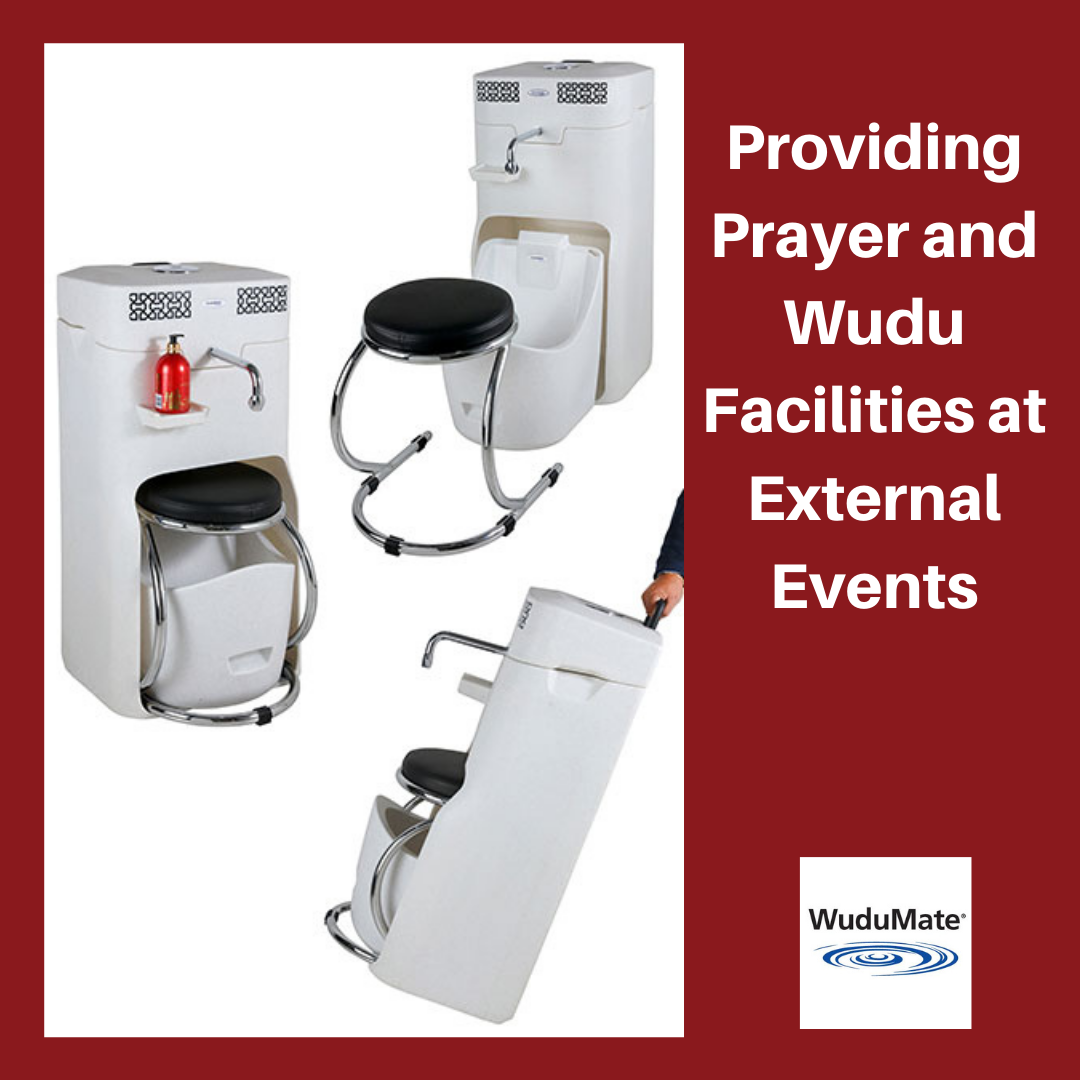
Portable Wudu Facilities
Where it is not possible to get easy access to mains water and drainage services, to provide a Wudu facility close to a suitable prayer area, it is possible to take a temporary wudu facility to the prayer area. The WuduMate Mobile is manufactured with integral clean and grey water reservoirs, and can be wheeled for use to a convenient location for Wudu.
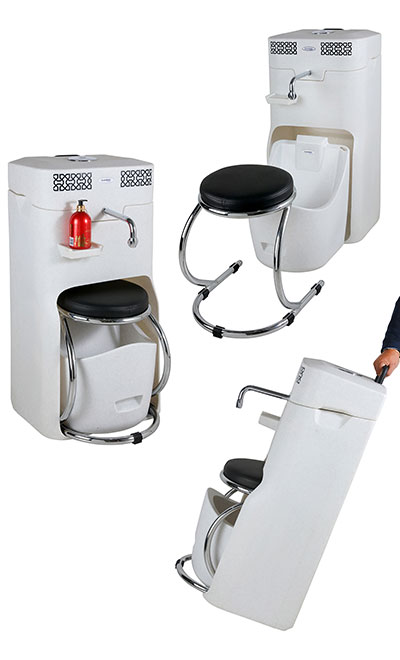
Typical applications could include:-
- Offices – when a temporary designated prayer area is not close to a usable wudu facility, the WuduMate Mobile can be filled in a bathroom, wheeled close to the prayer area, used to perform wudu, and then taken back to the bathroom for emptying.
- Hospitals/nursing homes – when patients are unable to get easily to a wudu facility, the WuduMate Mobile could be wheeled to the patient for use in their room.
- Hotels – when too few Muslim visitors justify wudu facilities in each room, the WuduMate Mobile could be wheeled to a Muslim-occupied room whenever required.
- Prisons & Police Stations – when it is inconvenient/unsafe to take a prisoner to a central wudu facility, the WuduMate Mobile can be taken to the prisoner.
- Exhibitions/events – when temporary wudu facilities are required, the WuduMate Mobile can be deployed wherever it is needed. This would even allow for wudu facilities where the designated prayer area is outdoors.
If you are planning an event at which you are expecting a significant number of Muslim guests, it is easy to provide for their prayer needs. Please contact WuduMate for any enquiries you have about our products.
This article is one in a series that has been extracted from our booklet DIversity Matters -a guide to Best Practice in the Design of Multi-Faith rooms. You can download the whole booklet, or read other articles in this series here:
“I didn’t always have a mineral water bottle to hand when I wanted to wash, and taking cups of water into a toilet is not always practical, so the WuduMate is ideal. It can be easily carried in your pocket or handbag, can hold a litre of water which is far more than the small water bottles which we normally use, and after use can be easily folded away again for use next time.”
Personal Washing at Work
We are all used to washing our hands after using the toilet, and when we are out in public we expect toilet facilities to be equipped for this basic hygiene protocol, which most people accept as normal.
When a toilet facility does not have adequate hand sinks, soap or drying facilities, it leaves the user feeling dissatisfied and uncomfortable.
However, did you know that some faiths also require the washing of intimate parts after using the toilet? This can be difficult for them to accomplish when away from home, where bidet facilities are rarely provided. A person from those faiths will often find that public washroom facilities fall short of ideal for their needs.
There are many ways in which the needs of these people can be accommodated in a workplace, school or public building. It’s an area that most people would be embarrassed to talk about or to ask for, but they would probably be delighted to know that someone had considered them, and that their needs were being catered for.
To download a pdf copy of the full booklet, please click the image above
Bidets
A conventional personal washing appliance in the home would often be a bidet, the personal nature of which dictates that it needs to be located in a private place.
This is rarely practical or cost-effective in a commercial environment – if a traditional bidet is installed in a public lavatory, there needs to be a one to one relationship between bidet to toilet, with both being located behind a locked door to ensure privacy. This is rarely cost-effective in a commercial or public sector environment.
Personal Washing in the Workplace
In order to undertake the required personal washing when away from home, some people will fill whatever container they can find (often a cup or water bottle) with water and take this to the privacy of a toilet cubicle to undertake this personal ablution act in private.
Using a single-use, plastic water bottle is environmentally unfriendly due to the wastage of plastic containers, or if the containers are returned after use, (such as a cup to a canteen) there is potentially a hygiene issue. In addition, when water containers are used in toilet areas, they can fall over causing spillages and result in slip hazards.
If your workplace or facility has a number of users who would welcome improved personal washing facilities, there are several other options that could be considered such as the following:
Douches
In many Muslim countries, it is customary to install hand showers (douches) behind public toilets, enabling washing of private parts with water (as with a bidet) after toilet use. The disadvantage of douches in a public environment is that they can be (and often are) stolen for home use, and careless use may cause spilt water that could pose a slip hazard.
In addition, it should be noted that most douche products will drip water when left under pressure, i.e. not turned off at the mains supply. To alleviate this, it is recommended that installations include an isolator valve for each user to use before/after use, but on the assumption, users will not turn this off after use, it is recommended that each douche spray is fitted with a time-delay valve to automatically turn the water off after use. It is also recommended that an adequate floor drain be located under the hanging position of the douche spray.
Bidet Toilets
There are a number of electronic bidet toilets available in the market, primarily designed for medical applications in the health sector, and due to their electronic, complex nature, they tend to be more expensive and therefore used more in the home.
Integrated Bidet
Increasingly popular are conventional style western toilets with a hand-operated bidet spout installed under the rim at the back of the toilet. This is sometimes called a Turkish Toilet. Care should be taken to consult local building regulations since it is likely some sort of backflow prevention system will be required.
Personal Bidets
For environments where the installation and maintenance of douches and bidet toilets is impractical, facilities managers may consider the provision of personal bidets for staff and visitors. The WuduMate Personal is a low cost, reusable, plastic container specifically designed for use as a personal bidet, and an excellent solution where no other suitable appliance is available.
WuduMate Personals
The WuduMate Personal can be conveniently folded after use and carried compactly in its own self-sealable pouch for future use, negating the need for random use of single-use plastic bottles and other unsuitable containers.
“I don’t always have a mineral water bottle to hand when I need to wash, and taking cups of water into a toilet is not always practical. The WuduMate Personal is ideal! It can be easily carried in a pocket or handbag, holds almost a litre of water which is more than the small water bottles which I normally use. After use the WuduMate Personal can be easily folded away again for use next time.”
Personal Bidet Dispensers
As employers become more familiar with the personal washing requirements of their staff, some are accepting that making an investment into readily available bidet facilities, will in the long term reduce water damage, avoid slip hazards and reduce cleaning costs, as well as increasing satisfaction amongst employees.
Providing Personal Bidet dispensers in suitable locations, either on a pay basis or even free of charge, is an easy to justify option.
When you travel abroad, you usually expect toilet facilities to be as you would hope to find them at home. How much do you think you would improve employee and user satisfaction and comfort, if you provided all of them with the kind of washing facilities that they are used to.
This article is one in a series that has been extracted from our booklet DIversity Matters -a guide to Best Practice in the Design of Multi-Faith rooms. You can download the whole booklet, or read other articles in this series here:
“I didn’t always have a mineral water bottle to hand when I wanted to wash, and taking cups of water into a toilet is not always practical, so the WuduMate is ideal. It can be easily carried in your pocket or handbag, can hold a litre of water which is far more than the small water bottles which we normally use, and after use can be easily folded away again for use next time.”
Ritual Washing in the Workplace
Most religions and cultures value cleanliness, with some practising ritual washing before prayer or mealtimes.
Christian monks used to practice ritual washing in a communal wash area known as a Lavatorium. Although generally abandoned, this custom has been replaced by the washing of hands before meals. Some observant Jews will wash their hands before prayer as a ritual undertaken as a devotion to God and an act of symbolic self-purification.
Wudu
Probably the most widely performed act of ritual cleansing is wudu, performed by Muslims before Salat (prayers). Wudu shows respect to God by bringing the adherent to prayer in a purified state. The actual practice of wudu varies between different Muslim groups, generally, however, it requires the washing of the face, head, hands, arms and feet.
Clean running water must be used except in some circumstances where no water is available. Contact with static or grey (dirty) water can invalidate the wudu ritual and should be prevented in any washing facility provided.
Wudu can take up to about three and a half minutes, and thus an appropriate number of washing stations need to be provided to cater for the probable number of people likely to want to perform wudu without causing too much of a queue.
o download a pdf copy of the full booklet, please click the image above
Imagine…
Imagine you are a conscientious, hard-working employee of a supermarket chain. You are a Muslim and in your daily life, you try hard to observe the quite demanding duties of ritual washing and prayer. But it’s not easy.
Your employer is sympathetic and tries to understand, but he does not really quite appreciate how difficult it is for you to find somewhere appropriate to carry out your religious duties in a quiet, dignified way which meets the requirements of your faith and personal aspirations without causing offence or distraction to colleagues.
You put up with having to wash your feet in the staff toilet in a wash hand basin over two feet high. You cringe when you put your bare foot back on the floor which is by now wet with unclean water and dangerously slippery. You brace yourself for the walk past non-Muslim staff to the storage area where you are allowed to say your prayers with the other four Muslims who work in the supermarket.
Your employer is really good to be so sympathetic. But you believe another employer not far away has gone even further to accommodate the religious needs of his multi-ethnic staff by implementing a purpose-built facility for wudu and prayer. Maybe you should make some enquiries… Could this be your washroom?
The Concept of a Clean ‘Taher’ Zone
In Muslim ablution terms, the organisation of a ‘clean zone’ aims at keeping the praying space free of organic traces, bad smells, and other things that render the praying space unusable for Salat or would upset those performing their prayers. It is therefore important in the design of the prayer area to define a line after which people should not be wearing their shoes, since these shoes might be carrying traces of road dirt.
The ‘line’ designating this clean zone can be a change of floor material, a small step or even a taped line on the floor; shoes should be left outside the clean zone; thus any shoe racks should also be located outside this zone. Toilets should obviously be outside this zone, ablution spaces though can be, and probably should be inside this zone. Conceptually, access to the ablution space can be from either outside or from inside the clean zone. Access from inside the clean zone can be either directly from the praying area or through a corridor or other types of links, but care must be taken to ensure no water is taken from the ablution area to the prayer hall.
Wudu in Washrooms
Many corporate bodies remain unaware of the importance of the washing ritual to Muslims and do not provide appropriate washing facilities. This leaves observant Muslims having, for example, to wash their feet in an ordinary hand basin in a toilet area. This not only shows a casual disregard for their needs but also creates very real and obvious health and safety hazards.
A solution is to provide tailor-made washing facilities which could be more closely associated with the prayer room – e.g. completely separate from toilet areas, which is a highly recommended approach if space can be made available.
The water used for wudu must be clean and flowing. Although not mandatory, in colder climates it should be pre-mixed to an ambient temperature before being dispensed.
Disabled Facilities for Wudu
If a sick or disabled person cannot do wudu with water because he is unable to do so, there is a dispensation that he/she can follow called ‘Tayammum’. ‘Tayammum’ literally involves the disabled/sick person ‘striking their hands on pure dust’, then wiping his/her face with the inside of their fingers and palms. In the likely circumstance, no ‘pure dust’ is available, other natural substances such as floor or wall tiles can be used.
Despite the above, it is suggested that ‘best efforts’ are made to accommodate disabled people in the wudu area, but it is extremely difficult to configure a disabled facility for wudu that caters for every type of disability.
Unlike disabled toilets where in many countries there is a published standard, there is rarely a standard for the provision of disabled wudu facilities. For any project outside the UK which requires wudu facilities, it is suggested that local regulations are checked to ascertain whether there are any documented standards for providing wudu facilities for disabled people in commercial buildings; if not, the following approach would be sensible.
It is suggested, that whatever arrangements are being considered for wudu, they should at least demonstrate ‘best efforts’ to cater for disabled users. If it can be demonstrated that ‘best efforts’ have been made to cater for the needs of the disabled in a wudu facility, these are likely to be accepted by any reasonable disability auditor.
WuduMate®
WuduMate is a unique range of washing appliances specifically designed for the Muslim ritual of wudu. Designed and manufactured by the Specialist Washing Company of the United Kingdom, (trading as WuduMate), a range of WuduMate models are available for use in the workplace, meeting all of the aforementioned requirements.
There are a number of WuduMate configurations which can be used to assist in this, with each WuduMate model configurable to some extent for disabled use, some facilitating wheelchair access better than others:
- WuduMate Modular – The WuduMate Modular can be configured without its stool for standing wudu, and as long as the WuduMate Modular is fitted flush with the floor, wheelchairs will be able to access this.
- WuduMate Classic – Requires wheelchair users to relocate to the WuduMate, just as they would to a toilet in a DOC M facility.
- WuduMate Compact – The WuduMate Compact stool can be fitted with a handle to assist in standing and or sitting, or the stool can be moved aside completely to enable wheelchair access.
- WuduMate Mobile – The WuduMate Mobile can be wheeled directly to a disabled person, for them to perform their wudu, rather than the disabled person needing to go to the wudu facility.
Conclusion
Allowing time for prayer and providing a designated space or a multi-faith room in a workplace is a big step towards inclusion of employees from different cultures.
However, especially if you have Muslim employees, it is also worth considering, and maybe consulting the employees themselves, as to what facilities would enable them to make their ritual ablutions comfortably and discreetly.
This article is one in a series that has been extracted from our booklet DIversity Matters -a guide to Best Practice in the Design of Multi-Faith rooms. You can download the whole booklet, or read other articles in this series here:
“I didn’t always have a mineral water bottle to hand when I wanted to wash, and taking cups of water into a toilet is not always practical, so the WuduMate is ideal. It can be easily carried in your pocket or handbag, can hold a litre of water which is far more than the small water bottles which we normally use, and after use can be easily folded away again for use next time.”
Safe and Comfortable Wudu at Home
It's possible that you have used one of our WuduMate units in your mosque, or if you have been visiting a public building and needed to pray while you are there.
I hope that you will agree that these units make the ablution process much more convenient and pleasant, compared to using traditional Western sinks.
Did you know that it is possible to have one of our WuduMates installed and plumbed in to your bathroom at home, or alternatively you can purchase a WuduMate Mobile for use at home, and use it in whichever room is most convenient to you and your family.
You can find out more about the units that we normally recommend for homes here:
If you would like more information about WuduMate for your home, please use this form and one of our sales team will be happy to answer any questions that you have.

Please click on the image above and you will be able to download it as a pdf document, which you can keep and show to the other members of your family.
“I didn’t always have a mineral water bottle to hand when I wanted to wash, and taking cups of water into a toilet is not always practical, so the WuduMate is ideal. It can be easily carried in your pocket or handbag, can hold a litre of water which is far more than the small water bottles which we normally use, and after use can be easily folded away again for use next time.”
Tips for Designing a Multi-Faith Room
This article is an extract from our booklet Diversity Matters – a guide to Best Practice in the Design of Multi-Faith rooms. To download a pdf copy of the full booklet, please click the image below
If you are planning a multi-faith room in your facility, the first thing you need to do is consider the cultural mix of potential users of your facility, and what they will be looking for if they wish to pray, read or meditate during the day.
Different faiths have different approaches to ritual duties and performance. For example, whilst Christianity is not demanding in terms of specific daily rituals, Islam requires Salat (prayers) be performed five times a day. This inevitably means that for proper observance, Salat will almost certainly occur at times during the ordinary working day.
If you have a significant number of Muslim users, it makes commercial sense to try to minimise the amount of unproductive time involved in getting to, using and returning from the prayer facilities provided. This can be achieved by having a multi-faith room close to individual work locations, in the same way as toilets are distributed for convenience around buildings.
Ideally, multi-building campuses should have a prayer room in each building, multifloored offices should have a faith room on each floor. A cost-benefit analysis would clearly demonstrate whether or not such an arrangement was justified with an overriding benefit being a saving of unproductive time, traveling to and from such facilities.
Having decided how many multi-faith rooms you need, and the location of them, there are several things you should take into account when designing each room.
To download a pdf copy of the full booklet, please click the image below
Room Size
The size of a prayer room should be commensurate with the number of people likely to use it at any one time. The requirements of Muslims are the most predictable, since their daily prayer routines take place at fixed times of the day determined by the times of sunrise and sunset. Furthermore, Salat follows a fairly fixed formula.
There are also defined times for Jewish prayer at least twice a day, again determined by dawn and dusk. However, there is more flexibility allowed to Jews who can usually pray early in the morning before work and in the later afternoon or early evening after work. Because the times for Muslim Salat are generally fixed, multi-faith rooms need to be large enough to accommodate all Muslim staff at one time,
It is unlikely that all Muslim staff will perform Salat every day, for example, females will not pray during their menstrual cycle, and prayer times on normal weekdays are more flexible than on Fridays, so it would be unlikely for all Muslim staff to be in the prayer room together. On Fridays however, it is obligatory for males to perform Salat in a group, similarly on days of Islamic significance (Eid and Ramadan).
Christians and adherents to most other faiths have no rigidly fixed times for daily prayers, so it is reasonable to assume that they would not choose to use the faith room during the times of Salat.
Each Muslim requires approximately 1.2m × 0.6m (4’ x 2’) of floor space on which to perform Salat. This enables them to place their forehead on the floor whilst kneeling, just touching shoulders with those on either side of them, so a prayer room should ideally be large enough to accommodate this number.
Provision needs to be made for ritual ablution prior to Salat (wudu) and this is discussed separately below. Ideally, entirely separate facilities for prayer and washing should be provided for Muslim men and women. However, if men and women are to share the same prayer room, women would normally stand behind the men separated by a curtain. In order to cater for varying numbers of men and women the curtain should be mounted on a moveable rail, so the position of the partition can be varied, alternatively, if no women are present, it can be removed altogether.
This same curtain partition would also be used by traditional Jews who pray publicly in a quorum of 10 men separated from any women present. It is entirely inappropriate to provide communal male and female washing facilities. Whether a single faith room or separate male/female rooms are provided, there will need to be separate washing facilities, unless the washing facility is behind a locked door to ensure privacy for women.
Orientation of the Prayer Room
For most faiths there is no fixed direction in which prayers should be said although the cruciform footprint of older Christian churches follows a predictable orientation. Jews generally pray facing east towards Jerusalem. For Muslims however, it is mandatory for them to face the Ka’ba during prayer. This is an ancient religious site located in the city of Mecca. Although the prayer room itself does not have to be orientated in any particular way, there should be some indication in it of which direction each wall faces – specifically the direction of east and of the city of Mecca.
The exact direction of Mecca obviously depends on where in the world/country the faith room is located. A compass is available from most Muslim bookshops which indicates the exact direction of Mecca. An arrow, positioned on the ceiling is also recognised as a practical means of indicating this direction and can be purchased from WuduMate.
Ideally, the entrance to the room should be situated to enable worshippers to enter and leave the room without passing in front of those at prayer.
Shoe Storage
Cleanliness plays a significant part in most religions, but some faiths have a specific requirement for shoes to be removed before prayer. All visitors to the prayer room should therefore be encouraged to remove their shoes before entering. A sign to this effect should be displayed, suggesting to those who do not wish to remove their shoes that, out of respect to others, they should avoid walking across the main prayer area.
There should be an area where shoes can be removed prior to entering the faith room or associated washing areas, and a rack in which visitors can leave their footwear once removed.
Toilet Facilities
It is not mandatory to have toilet facilities installed within a prayer room environment, however if they are included, it should be remembered that Muslims should not use a toilet facing the same direction in which they pray, i.e. facing Mecca. In addition, for a number of reasons, Muslim men will generally not use urinals, and prefer to urinate seated to standing, in the privacy of a toilet cubicle.
It is suggested therefore, that when planning the location and design of toilets in the workplace, if a higher-than-normal percentage of staff are likely to be Muslim, more cubicles and less urinals are provided than might be normal, and urinals are excluded altogether from multi-faith areas.
It should also be noted that some ethnic groups (including Muslims) require to wash their personal parts with water after using the toilet, rather than using paper, in other words, they require a private bidet facility.
Fixtures and Fittings in the Prayer Room
Religious Icons
The permanent presence of religious icons for one particular faith group can offend other religious groups and can create an atmosphere of ‘possession’ by one group. If the use of icons is specifically required by a particular religious group, there should be a cupboard for their storage when not in use. Ideally there should be a minimum of four such cupboards (to represent four of the major faiths).
There are cupboards available which look like bookshelves from the front, but when opened up have different designs inside; once the outer doors of the cupboard are opened, internal designs can include:
- A shelf-like Christian altar, on which other Christian artefacts can be placed such as a cross or Bible, with cupboard space underneath.
- Muslim designs and graphics to look like a mini-mosque; appropriate lighting can also be installed in the cupboard.
Furniture
Furniture is not a mandatory requirement in a multi-faith facility, it is appropriate however to provide some informal seating for more casual visitors to use when reading or simply sitting in contemplation.
A simple table should also be provided for items required by some faiths as part of their ritual. Christians, for example, would appreciate the presence of a cross or crucifix to denote an altar. Jews might use a table for study, which is usual for them before, during or after prayer.
Ideally any furniture should be capable of being easily moved away from the central area of prayer. Such relocation should not be to the wall which people of particular faiths would face in prayer. The use of benches would be acceptable but there should also be some movable chairs for those who wish to sit at the table, or who find it difficult to kneel. The use of leather furniture should be avoided since Hindus cannot accept leather in their places of worship.
Floor Covering
The covering of the prayer room floor should be in a neutral colour, so as to be acceptable to all faiths. It needs to be easy to keep clean.
Books and Religious Reading
Books and other religious publications such as calendars could be made available, but nothing should be left in permanent view, so as not to offend those of other faiths. It should instead be stored on a shelf or preferably in a cupboard. Material for promotional or advertising purposes should not be allowed.
Leather covered books should be avoided due to the offence caused by cow hide in religions such as Hinduism (see 5.6.2 above).
Lighting
The prayer and washing areas should be well lit – ideally, in today’s environmentally aware world, with energy saving devices.
Windows
Windows will assist with the lighting and natural ventilation of the prayer room, but users might prefer obscure glass to be used. Stained glass windows can add to the aesthetic appeal of the décor, but the subject matter should be neutral with no religious connotations.
Other
Prayer caps, mats, cushions and other items should be kept in cupboards so as not to cause offence. The burning of incense may contravene fire regulations and run the risk of activating smoke sensors and should be strongly discouraged.
If the use of candles is to be allowed, this should be closely monitored and supervised. Appropriate legislation must be consulted, and a risk assessment undertaken. Ideally no more than one or two candles should be lit at any one time and should not be ‘religion-specific’.
Other Places of Worship
Contact details and addresses of other local places of worship such as churches, mosques and synagogues should be available. If the faith room is to be locked when not in use, a notice to this effect should be posted outside.
Signage
Statutory Signage
Statutory notices such as “No Smoking”, “Fire Exit”, “No Naked Flames” and any others that may apply to fire regulations and other legislation should be displayed.
Multi-faith and Wudu Room Signage
Different signs are recommended to suit the layout of the Multi Faith facilities, these could include the following: PRAYER ROOM, MULTI-FAITH ROOM, QIBLA
This article is one in a series that has been extracted from our booklet DIversity Matters -a guide to Best Practice in the Design of Multi-Faith rooms. You can download the whole booklet, or read other articles in this series here:
“I didn’t always have a mineral water bottle to hand when I wanted to wash, and taking cups of water into a toilet is not always practical, so the WuduMate is ideal. It can be easily carried in your pocket or handbag, can hold a litre of water which is far more than the small water bottles which we normally use, and after use can be easily folded away again for use next time.”
The Challenges of Diversity in the Workplace
Across the world, populations are increasingly multicultural and multi-ethnic. Our places of work, hospitals, universities and colleges are emphatically multicultural.
It is a well-established reality that staff, patients, students and visitors can be expected to come from a dazzling array of cultural backgrounds and faiths and as such, we must accommodate their varying needs.
Such diversity raises a range of challenges for employers, property owners and managers, facilities managers, architects and interior designers. Not least of these challenges is the moral and increasingly, legal obligation to recognise social and religious diversity in the facilities provided in the workplace. Increasingly legislation extends these obligations, which previously only applied to employers, to include all providers of goods, facilities and services to public bodies and private organisations.
In the UK, The Confederation of British Industry notes: “Employers recognise the benefits of effective diversity and inclusion policies, and the business community supports positive action. The one resource that in today’s knowledge-based economy gives sustainable competitive advantage, is the skills, understanding and experience of people. Discrimination in employment, wherever it exists, squanders effort, ideas and, ultimately, business sales. It leads to wasted potential, wasted labour and wasted revenues”.
Although there is no shortage of information on the general topic of diversity there is a distinct lack of practical, down-to-earth guidance on what that means in our places of work and study and the places we visit such as hospitals and other public buildings. Typical grey areas include:
- What are the day-to-day implications of diversity we need to grapple with, when considering the provisions made for staff and visitors?
- How do we ‘design in’ to our new buildings the demands of diversity?
- How can we try to reflect these demands and expectations in existing buildings?
To download a pdf copy of the full booklet, please click the image above
Our Diversity Matters guide is intended to provide practical guidance on the provision of multi-faith facilities to those responsible for the design and management of public and commercial properties and to employers who all have a duty of care for an increasingly multi-ethnic workforce. Most western countries seem to be following the UK’s more prescriptive policies regarding diversity in the workplace. This guide, therefore, provides a suitable benchmark for other countries to follow.
The Benefits of Recognising and Accommodating Cultural Diversity
The provision of equality statements in employment Terms & Conditions is commonplace – reflecting an employer’s statutory obligations. However, such considerate HR policies should not simply be driven by the need to meet legal obligations. Being proactive about the diverse needs of a culturally diverse workforce can produce real practical and financial payback. Reduced absenteeism, lower staff turnover, improved morale and loyalty, can all be the very tangible results of enlightened staff relations.
Gymnasia, canteens and staff lounges are already recognised as good practice by many large employers who see practical and commercial benefits in improving the ways they cater for the well-being of their staff and visitors; by providing great places to work, employers can entice the best employees.
Some businesses go further:
- Recreation facilities with games and musical instruments
- Sports facilities
- Sophisticated “relaxation chambers”
Businesses are increasingly providing facilities for the “physical” wellbeing of the staff, however fewer companies or public service organisations have given the same thought to the spiritual needs of their diverse workforce and visitors.
In today’s pressured world, there is real need for people to have a quiet space for reflection, meditation or prayer in the workplace, to which they can retreat when necessary during the day. If such space is to be used for prayer it must, by law, be available to everyone without discrimination. It must, therefore, provide for the traditions of different faiths without causing offence to any. Hence the concept of a multi-faith room or quiet room as it is sometimes called.
Since the most recent UK legislation includes ‘lack of faith or belief’, in its definition of religion and belief for the purpose of establishing discrimination, such a room would potentially benefit any and every individual by providing a clean, quiet space, while avoiding the appearance of different treatment for different people with different beliefs.
- Most hospitals already provide a variety of multi-faith facilities for use by staff, patients, their relatives and visitors. Such facilities are, of course, especially relevant where there is personal suffering and distress. An opportunity for those affected by such circumstances to spend time in solitude in a dignified environment can be a vital part of the healing process – both physical and spiritual.
- Courts are places where stress can be alleviated by a few moments of quiet contemplation or prayer. Furthermore, some faiths, including Islam, require spiritual preparation before the taking of an oath on their holy book. Such preparation might also involve ritual ablution.
- Many government buildings, both national and local, such as prisons and libraries, are installing multi-faith facilities – for a while achieved by converting redundant smoking rooms, but these have long since disappeared, so other spaces need to be found.
- Airports generally provide prayer and ritual washing facilities for both travellers and staff.
- The armed forces are increasingly providing for the spiritual needs of members of all religions, both in barracks and in the field, and also to accommodate Muslim visitors from overseas who visit these facilities for training.
- Universities and colleges are leaders in encouraging multicultural tolerance and understanding. Faith rooms not only provide for worship by different faith groups, they also encourage interaction and mutual understanding.
- Large corporations and multinational employers are becoming more faith aware.
This article is one in a series that has been extracted from our booklet Diversity Matters -a guide to Best Practice in the Design of Multi-Faith rooms. You can download the whole booklet above, or read other articles in this series here:
- Personal Washing at Work
“I didn’t always have a mineral water bottle to hand when I wanted to wash, and taking cups of water into a toilet is not always practical, so the WuduMate is ideal. It can be easily carried in your pocket or handbag, can hold a litre of water which is far more than the small water bottles which we normally use, and after use can be easily folded away again for use next time.”
Features & Benefits of the WuduMate Modular
If you are considering any investment in a new ablution area or refurbishment of an existing one, you will want to be sure you are maximizing the benefits of any spend on this project.
To assist you in this task, please find detailed below the features and benefits of the Wudumate Modular.
Fitted together for Communal Ablution
As the name Modular would suggest, the WuduMate modular can be installed singly or fitted together in series, to provide a single, waterproof fixture for communal ablution, with as many washing positions as can be fitted in the space available.
Each WuduMate Modular unit is 700mm (27 inches) wide.

12 WuduMate Modulars in UK Mosque Project
Seated and Standing/Disabled Positions for Wudu
In some parts of the world, specifically South East Asia, standing wudu is preferred to seated wudu, and this preference seems to be on the increase in the West, especially for those dressed in western attire who may have to return to the office after salat.
Seated and Standing Wudu
Whilst the WuduMate Modular is generally installed with a stainless steel seat pole and seat top for seated wudu, the WuduMate Modular also includes a compatible alternative which is a Modular configured without a seat for those who prefer to perform their wudu standing.
The availability of standing positions for wudu can only broaden the appeal of a mosque to those who might prefer to stand rather than be seated.
Wudu for Wheelchair Users and Disabled People
When the WuduMate Modular is configured for standing wudu, it can also be used for wheelchair access, by setting the units into the concrete slab, and tiling up to the back of the WuduMate. Installation of even a single standing unit in a row of seated units, will help meet DDA (disability) compliance.
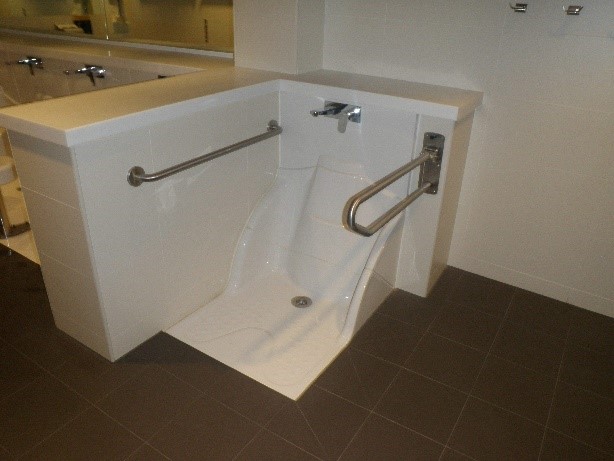
Control of Splashing
The shape of the WuduMate Modular, combined with the location of the spout and the angle of the spout, is designed to provide both the most comfortable position for wudu, but importantly to also minimise splashing of grey water on the person performing wudu or his/her clothes.
Water Management/Efficiency
Whilst tap/faucet preferences vary (sensor /manual etc) WuduMate is proud of its water management features, which include a number of significant water saving options with every WuduMate model.
Every WuduMate tap/faucet includes a 3.7 lpm (1 US gallon) PCA regulator, to:
- Limit the flow of water to 3.7lpm (1 USG)
- Equalize the water pressure (PCA) across each series of taps/faucets, ensuring water flow leaving all the taps in a series is equal. This avoids the tap/faucet nearest the source running fast, and the tap/faucet furthest from the water source running slowly.
The Neoperl 1.8 lpm PCA aerator (0.5 US Gallon) is also available as an option for each tap which potentially halves the water usage, and thus halve the cost of the water itself but also reducing the cost of heating the water.
There are a number of other water saving devices available with each WuduMate model, although some of these do negate the aerator benefits outlines above. (Refer section Water savers below.)
Tap/Faucet Options
The recommended installation design of the WuduMate Modular using a shallow stud wall (framework) with shelf top, makes it possible to easily install several different type of taps/faucets, using the cavity of the framework to store the plumbing.
WuduMate ¼ Turn Wall Mounted Tap/Faucet
The most widely used WuduMate Modular tap is the WuduMate ¼ turn Wall-Mounted Tap. This tap/faucet requires a single source of premixed water, either mixed by a TMV (Thermostatic Mixing Valve) or provided centrally; water flow is controlled by a ¼ turn on/off mechanism located at the end of the spout.
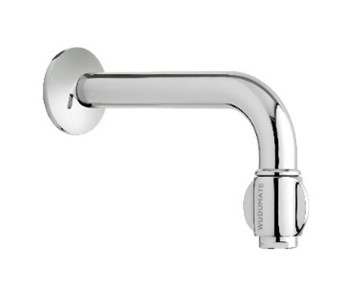
Benefits of the WuduMate ¼ turn tap include:-
- Extremely robust; research has shown that taps/faucets in Wudu areas are quite often used by the elderly as handles to assist standing up and sitting down, so we have deliberately manufactured the ¼ turn WuduMate tap with a thicker walled tube than is normal for additional strength.
- Minimal maintenance; there is very little that can go wrong with the WuduMate ¼ turn wall mounted tap, probably only a replacement cartridge (maybe after 5+ years), which can be changed easily without having to de-install the tap/faucet, probably not even involving the services of a plumber.
- The WuduMate ¼ Turn Manual Tap/Faucet can be fitted with an optional ‘wrist blade’, which is an extension to the tap on/off mechanism which can be operated by the wrist, making it easier for disabled people to use, and more hygienic in so much that it can be turned on/off with the back of the hand.
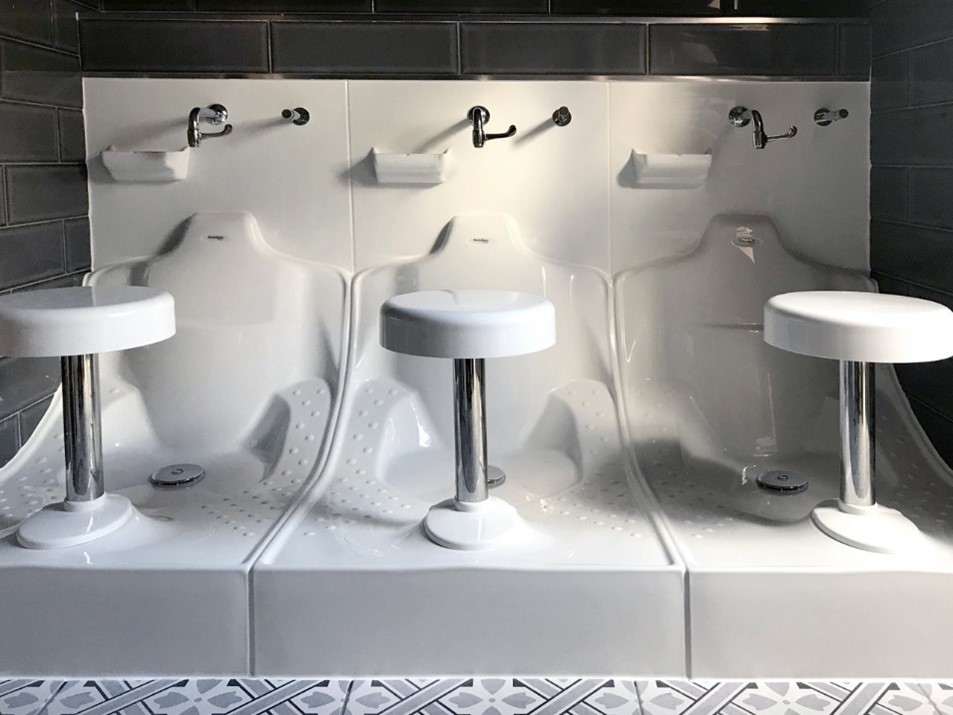
WuduMate Wall Mounted Non-concussive Time Delay Tap/Faucet
The WuduMate non-concussive (time delay) tap/faucet is operated by a push-button on the end of the tap/faucet, giving a 7 second supply of water prior to requiring another push for a further 7 seconds and so on. Non concussive taps can misbehave when water quality is poor, so installation of an in-line filter is recommended with each tap/faucet.
Non-concussive taps are intended to save water, but if a tap malfunctions there is a risk of water running uninterrupted, and if wudu is finished after 3 seconds of a 7 second run, 4 seconds of water would be wasted. Water saving claims should therefore be treated with caution.
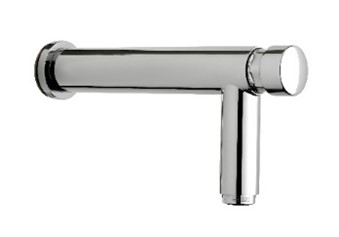
non-concussive tap/faucet
WuduMate Wall Mounted Sensor Tap
Like all auto sensor taps, the benefits of the WuduMate Wall Mounted Auto Sensor Tap/faucet are well documented; in theory the 7 second on/off water cycle should help save water and all auto sensor taps have hygiene benefits in so much as it is not necessary to physically touch the tap/faucet to turn the water on/off. All sensor taps are however considerably more expensive than manual taps, and may well require maintenance over their expected life span, especially if mistreated as they can be by some (e.g. children sticking gum on the sensor to ensure continued running).
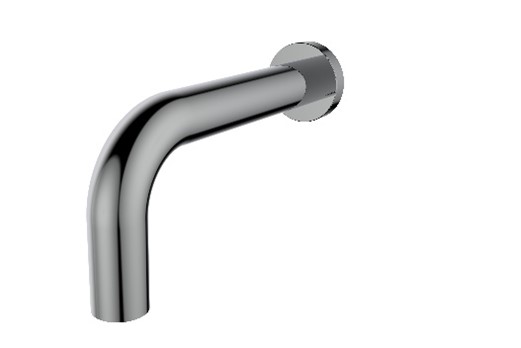
Use of Acrylic for Manufacture
A number of materials could be considered for manufacture of a communal ablution facility:-
Tile & cement
When we first reviewed what materials were traditionally used for building communal ablution areas, tile and cement was by far the most common, and probably still is. We experimented with ‘solid surface’ (Corian like material) and considered stainless steel which we found was expensive and dangerously slippery.
After careful evaluation of material options, high-quality sanitary grade acrylic was deemed to provide the most benefits for the WuduMate Modular:-
- Stainless steel was considered too institutional and lavatorial, and the cost to produce a ‘free form’ tool was too expensive, meaning the unit had to be ‘fabricated’ with sheet metal and welds; this method of manufacture results in angular corners which are difficult to keep clean, and can thus potentially harbour bacteria.
- Solid surface had its attractions and we spent many 1000s of pounds working with both proprietary Corian and other solid surface options, but ultimately found it dangerously slippery for feet, too difficult to join seamlessly, and too expensive.
Acrylic is a material which is widely recognised as ‘best practice’ for washing appliances, with its shiny surface facilitating cleaning, reducing maintenance and helping to reduce the incidence of bacteria that spreads foot-borne diseases.
Not only is acrylic easy to keep clean using normal household detergents, it also has the benefit of showing when cleaning is required. When unclean, acrylic loses its sparkle, helping users instigate an appropriate cleaning regime to combat unwanted bacteria, which can otherwise lie unnoticed in tile and cement structures where dirt and bacteria is not easy to see.
Some have questioned whether acrylic is strong enough to support the weight of a large person performing wudu, thus the WuduMate Modular seat is supported by a steel frame, to ensure that the weight on the seat is directed through to the floor rather than onto the acrylic of the unit itself, thus supporting the heaviest of users. The WuduMate Modular seat system has been tested by CERAM (wwww.ceram.com) for weights up to 500kg.
Individual Waste with Trap
Individual traps/wastes improve hygiene and reduce unpleasant odours. The fundamental design of a ‘trough’ based ablution unit, dictates that each person’s ‘grey water’ runs in front of those ‘downstream’, increasingly considered unhygienic, and prone to produce unpleasant odours.
WuduMate have standardised on the UKs leading drain manufacturer MacAlpine, to ensure that the WuduMate installation is of highest quality with minimal maintenance requirements.
Multi-Positional Stainless Steel Seat-posts
The WuduMate Modular Seat poles are manufactured from high quality stainless steel, to avoid rust and to be long-lasting. Twin-walled black or white acrylic seat tops provide an easy to clean, resilient seat, the new aluminium tops in silver and gold are increasingly popular, and the beech option with chrome trim is another cost effective option to consider.
The WuduMate Modular seats can be located in a forward position for children’s use, or with the pole located at the back of the mounting area for adult use.
Seat Support Bracket
To hold the seat poles firmly in place, the seat pole is supported by a sturdy steel structure under the WuduMate which sits on the substrate (floor base) under the WuduMate. This combination transfers the weight of the person seated on the WuduMate seat, directly to the floor rather than onto the surface of the WuduMate.
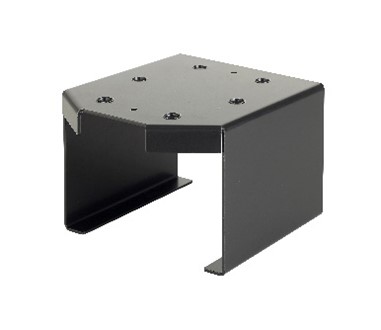
Seat Pole Base Cover
To help keep the seat pole base clean and disguise the fixings holding the pole in place, there is an optional seat pole base cover, manufactured in sanitary grade acrylic to match the colour of the seat top, whether Black or White.
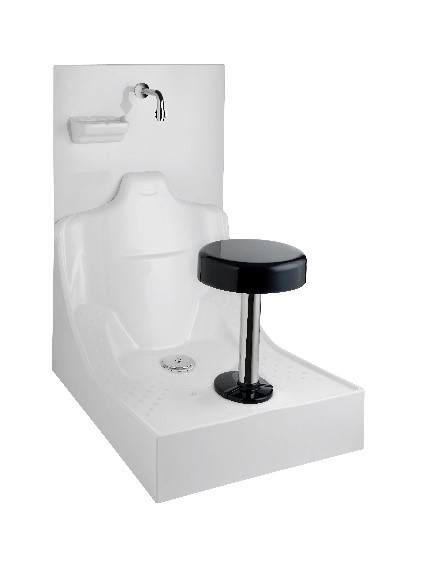
Optional Soap Dispenser
Optional, integrated soap dispensers improve hygiene, reduce waste and minimise shelf and wall clutter.
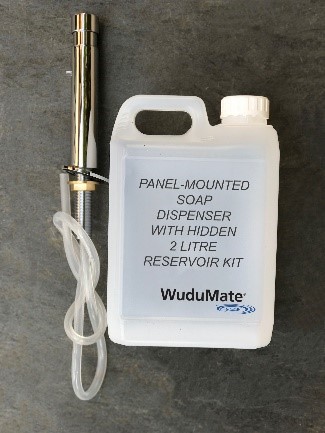
Decoration
Generic decoration (decal patterns) are available in a number of colours and standard designs, to give aesthetic appeal to the WuduMate; alternatively customisable patterns can be produced, perhaps to complement patterns used elsewhere in a mosque such as a ‘frieze’ around the outside of a building.
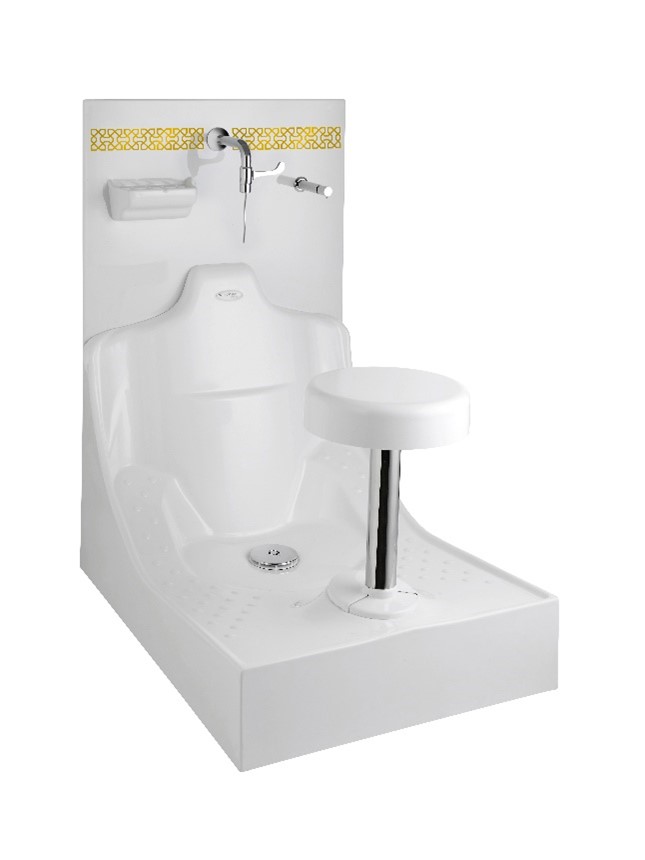
Other decoration opportunities
High quality white acrylic provides opportunities for imaginative downlighting to increase aesthetic appeal of the ablution area, extremely effective when used in conjunction with mirrors.
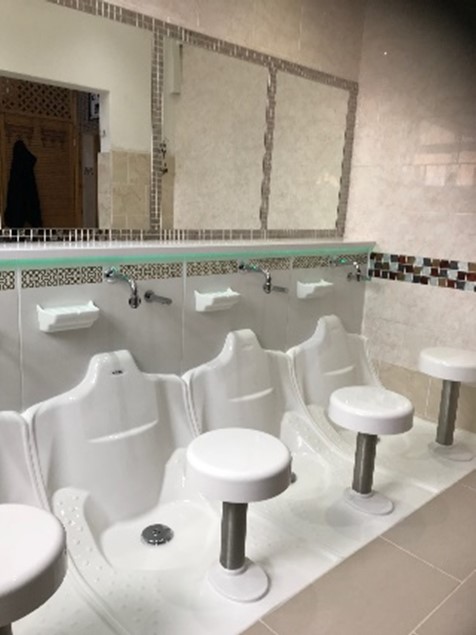
Framework and Shelf Top
The WuduMate Modular should ideally be installed against a wooden/steel frame fixed to the wall, with a minimum gap of 100-120mm depth, sufficient for a plumber’s access when required for maintenance. This framework provides a number of benefits:
- The WuduMate Modular needs to be affixed to a vertical wall, and since walls, especially in older buildings, might not be vertical, a shallow framework with vertical front ensures a vertical fixing, also saving rework of the wall (e.g. replastering).
- A shelf can be located on the top of the framework, and can be used to hold personal belongings when performing wudu (hats and watches etc.).
- The gap within the framework provides a neat location for plumbing, access to taps for maintenance purposes, reducing potential dirt traps and facilitating cleaning.
- The gap within the framework provides a location for the main waste to run horizontally in the floor at the base of the framework.
- The gap within the framework provides a location for a hidden soap dispenser reservoir, which can either be filled through an access hole in the shelf top, or by removing the shelf top.
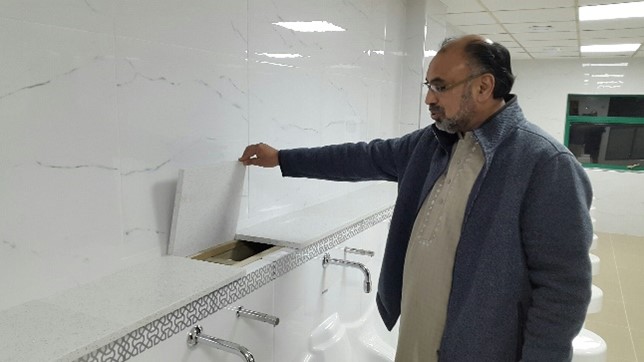
Conclusion
Whilst there can be a reluctance from some to implement a modern, state of the art ablution system in favour of a traditional trough system, our experience tells us that the benefits provided by the WuduMate are becoming increasingly important to many, especially the younger generation and young professionals who are used to bright, well lit, more hygienic environments at home.
As more and more of us have access to modern bathroom facilities at home and at work, there is increasingly an expectation that an ablution environment in the mosque should be of similar quality, hygiene, and overall aesthetic appeal as a bathroom at home. Visitors to mosque ablution areas perform wudu as a ritual cleansing, and should not be put at risk of leaving an ablution area with more harmful bacteria on their feet than when they arrived. With the ready availability of the WuduMate Modular, there is no longer a reason why this should be the case.
You can find technical specifications and an installation guide for the Wudumate Modular here
Please contact us on info@wudumate.com or fill in our Contact form if you have any questions about this product or any others in our range
“I didn’t always have a mineral water bottle to hand when I wanted to wash, and taking cups of water into a toilet is not always practical, so the WuduMate is ideal. It can be easily carried in your pocket or handbag, can hold a litre of water which is far more than the small water bottles which we normally use, and after use can be easily folded away again for use next time.”
WuduMate attending Real Estate Development Summit in Egypt
We look forward to catching up with some of our international contacts at the Real Estate Development Summit in Cairo at the end of the month.

“I didn’t always have a mineral water bottle to hand when I wanted to wash, and taking cups of water into a toilet is not always practical, so the WuduMate is ideal. It can be easily carried in your pocket or handbag, can hold a litre of water which is far more than the small water bottles which we normally use, and after use can be easily folded away again for use next time.”
WuduMate Frequently Asked Questions (FAQs)
Read our the Frequently Asked Questions (FAQs) we get asked about us and our products.
Product Usage and Features
1. Q: What is WuduMate?
– A: WuduMate is a specialised range of products designed to facilitate the Islamic practice of Wudu (ablution). It offers a convenient, hygienic, and efficient way to perform Wudu, suitable for homes, mosques, workplaces, and multi-faith rooms.
2. Q: Can WuduMate products be used for other practices?
– A: Yes, WuduMate products are versatile and can be used in multi-faith rooms to accommodate other practices which may require washing or purification
3. Q: How do I install a WuduMate unit?
– A: Installation of WuduMate models is straightforward and can be undertaken by any semi competent plumber. Detailed installation guides and videos are available to assist installation.
Maintenance and Cleaning
4. Q: How often should I clean my WuduMate unit?
– A: For optimal hygiene, we recommend cleaning your WuduMate unit as you would a shower tray in your home, with a mild detergent and water. Regular maintenance will keep it in excellent condition.
5. Q: What cleaning products are safe to use on WuduMate units?
– A: Use mild, non-abrasive cleaners to avoid damaging the surfaces. Avoid bleach or harsh chemicals.
6. Q: How do I prevent water stains on my WuduMate unit?
– A: All WuduMate models are manufactured in materials proven in sanitaryware applications (e.g. porcelain and acrylic) which are designed to be resistant to staining, in the same way basins showers and baths are in the home. Regular cleaning will ensure WuduMates are potentially a lifetime investment.
Customisation and Options
7. Q: Are there different sizes and models of WuduMate units available?
– A: Yes, There are a number of WuduMate models to suit different needs and spaces, to suit virtually any building type. Please refer https://wudumate.com/wudu-foot-baths/ to compare the sizes and features of our different models
8. Q: Can I customise the colour and design of my WuduMate unit?
– A: The primary colour for all WuduMates is white; experimentation with black and black & white has proven to be unpopular due to the difficulties in keeping black looking clean. (similar to black cars!) The WuduMate Modular however has numerous customisation options to match customers specific preferences including different coloured seat tops, and a number of standard designs of decoration and the option to customise these designs.
Accessibility and Inclusivity
9. Q: Are WuduMate units accessible for people with disabilities?
– A: Absolutely. Most WuduMate models can be configured to provide accessibility and comfort for people with disabilities and limited mobility. Many can be used by wheelchair users Please refer to the individual models for details.
10. Q: Can children use WuduMate units safely?
– A: All WuduMate models can be used by children, we recommend though that the WuduMate Compact, WuduMate Mobile or WuduMate WuduBasin are utilised if younger children will be using the unit regularly, as the stool can be moved, allowing the child to sit at the optimum distance from the water outlet in terms of comfort and safety. We would always recommend supervising very young children when using our units.
Technical Specifications
11. Q: What are the water usage rates for WuduMate products?
– A: All WuduMate units are designed to be water-efficient with aerators limiting flow to 3.7lpm (1USG) or optional 1.8lpm (0.5USG).
12. Q: What materials are WuduMate units made from?
– A: WuduMate units are constructed from high-quality, durable materials that are proven in sanitaryware applications designed to be resistant to water and wear & tear, ensuring long-lasting use
Purchasing and Shipping
13. Q: Where can I purchase WuduMate products?
– A: WuduMate products can be purchased directly from WuduMate or through authorised international distributors. The best option is to email sales@wudumate.com giving details of your application and location so our sales support team can advise the best model based and the most cost effective delivery methods; if you already know which WuduMate model you are interested in, request a specific quotation.
14. Q: Do you offer international shipping?
– A: Yes, we offer international shipping to any countries where we do not have international distributors with local stock. Shipping costs and times vary based on location. Please check our website for more details.
Warranty and Support
15. Q: Do WuduMate units come with a warranty?
– A: Yes, all WuduMate units come with a one year manufacturer’s warranty covering faulty materials & workmanship. Please refer to the warranty information provided with your product for details.
16. Q: Who can I contact for technical support or service inquiries?
– A: Our customer support team is here to help with any technical support or service inquiries. You can reach us via phone, email, or through our website’s contact form.
Health and Hygiene
17. Q: How does using WuduMate improve hygiene?
– A: WuduMate units are manufactured using anti-bacterial materials wherever possible, with every model having its own individual waste to ensuring a cleaner and more hygienic ablution process compared to the traditional troughs often used for wudu.
18. Q: Are there any health benefits to performing Wudu with a WuduMate unit?
– A: Yes, performing Wudu with WuduMates promotes better hygiene and can reduce the risk of foot infections and skin conditions often lying resident in damaged tiled floors where bacteria cannot be seen as it can on a shiny white WuduMate.

“I didn’t always have a mineral water bottle to hand when I wanted to wash, and taking cups of water into a toilet is not always practical, so the WuduMate is ideal. It can be easily carried in your pocket or handbag, can hold a litre of water which is far more than the small water bottles which we normally use, and after use can be easily folded away again for use next time.”